Thursday, January 12, 2012

The Grass IS Greener on the Other Side.

With the exception of alcohol and nicotine recreational drug use is illegal in most places in the world. Most take it so seriously that using drugs will get you fired, expelled or even some jail time. Supplying drugs is very likely to result in jail time, and in a few places will get you executed. It’s reasonable to conclude that drugs must constitute a serious threat to social order and wellbeing, if so many societies punish it so harshly. Stories of the problems drug users can cause families, not to mention the violent crime around the supply chain, seem to reinforce this view.

On the other hand a World Health Organization survey found quite high user rates. In the US for example 42.4% of adults used marijuana. If such a high proportion of the population use it, without society collapsing, can it be so bad? Some don’t think so. There have been many attempts to have marijuana use made legal. Generally these attempts have failed but in a few places they do succeed.

In this article I turn the torch of intelligence on the issue of marijuana legalization.

The Smart Vote is clearly for legalizing marijuana, or grass. The graph below shows the support, by IQ level, over time. There was a major drop in support during the Reagan and Bush administrations but support has steadily increased since then. It doesn’t look like changes in support for legalizing grass have much to do with intelligence. Nevertheless at all times there was a clear ordering of support for legalizing grass along IQ lines i.e. the Smart Vote always pointed toward legalizing grass being the correct idea.


Maybe the Smart Vote effect is just due to special interests. Recreational drug use is after all something more common in affluent societies and groups. I ran two separate logistic regressions so that the downward trend over time till 1992 and the upward trend since then would hide each other or dampen any other effects. The table below shows the results.


The different trends for the two time periods show up very clearly. As expected youth, being more liberal or male go with support for legalizing grass. On the other hand that education and income are unrelated is unexpected. For our purposes though the association between higher IQ and support for legalizing grass holds up when these confounding variables are controlled. The independent effect of IQ is so strong that it has a less than 1 in 10000 probability of being due to chance. We can therefore rule out interest biases relating to these variables accounting for the Smart Vote.

But why should legalizing grass be the correct thing to do?

Economists have long argued that the war on drugs is counterproductive. For example of Chicago University’s Economics Expert Panel 100% agreed that making drugs illegal raises the street price of the drugs because suppliers require extra compensation for the risk of incarceration and other punishments. 79% of them agreed that the Netherlands restrictions on “soft drugs” combined with a moderate tax aimed at deterring their consumption would have lower social costs than continuing to prohibit use of those drugs as in the US. Only 2% disagreed and the rest were uncertain.

The evidence suggests these economists are right. Attempting to outlaw an essentially victimless crime (or very low victim), greatly encourages serious crime with a far higher victim count. The experience of the Prohibition in the USA strongly supports this. Policing drugs uses up resources and manpower that could be better employed elsewhere. Furthermore, if it were legal it can be used as a government revenue stream.

With respect to drug usage becoming a social problem, note that making drug use illegal doesn’t reduce the actual use of them much, if at all. Some places where cannabis is illegal, like France or the US, have higher user rates than some places where it is basically legal, like the Netherlands or Spain. The US has a user rate of 42.4% for marijuana and 16% for cocaine. For the Netherlands the rates are 19.8% and 1.8% respectively. Furthermore the Netherlands has about 60% of the problem drug user rate as similar countries in Europe. It looks like the other measures the Netherlands takes to discourage drug use work quite well.

It makes no sense for something to be illegal if it is demonstrably less harmful than something which is legal. Yet cannabis continues to be illegal in most places, in spite of scientists classifying it as a ‘softer’ drug than alcohol.

Legalize grass (and maybe recreational drugs in general) – it’s the right thing to do.

Monday, January 9, 2012

The Stupidity of Opposing Gay Rights

Homosexuality, “the love that dare not say its name”, is far more widely accepted than it used to be. People aren’t jailed for being gay anymore, and gay bashing is way down. Overall public support for the right of homosexuals to marry has quadrupled, and opposition nearly halved, between 1988 and 2010. Opinion is evenly divided on whether homosexuality is a choice or something that cannot be changed. Almost all gays of course think it isn’t a choice and that they should have the right to marry.

Still a great deal of opposition to homosexuality remains. It’s regarded as unnatural, sinful, immoral, debauched, promiscuous, an aberration and a threat to normal ways of being and not too long ago was classified as a mental illness. While support is increasing for gay marriage resistance to it is formidable. For example 42 states define marriage as the union between one man and one woman and 30 of these states have gone so far as to add amendments to their constitutions banning gay marriage, in order to make any future recognition far more difficult. In 18 states the constitution bans any kind of same sex union. Some states grant some rights to same sex unions e.g. right of hospital visitation. Only 5 states have, or soon will, recognize same sex marriages and a total of 6 (plus the District of Columbia) recognize some form of same sex civil union or domestic partnership.

One would like to know whether homosexuality is a threat to be concerned about and contained or discouraged, or whether it is a normal harmless option that should be embraced, or is it something in between? In this article I will look at what light intelligence can shed on this. My information comes from the General Social Survey and Kinsey’s two volumes on Human Sexuality.

Is Homosexuality a Choice?

Here the Smart Vote is very decidedly for homosexuality not being a choice. Nearly 2/3rds (63.5%) of those with IQs below 88 believe gays chose to be homosexual. In contrast 74.3% of those with IQs above 116 believe sexual orientation is not something that can be chosen. This association holds up when confounding factors like education, political ideology and gender are statistically controlled (see the right hand column in the table “Regression Analysis of Attitudes toward Homosexuals” below.)

The Smart Vote is broadly correct but strictly speaking the true situation is a bit more complicated. Some people can change their sexual orientation. Occasionally the anti-homosexual therapy practiced by some fundamentalist Christian churches does work. In response to the AIDS crisis there was a detectable increase in the proportion of both sexes who had sex exclusively with women. Furthermore, gay sex between female swingers is very common – even among those with a long pre swinging history of exclusively male partners. This suggests that to some extent – at the margin as economists would say - sexual orientation is susceptible to incentives.

Nonetheless it’s also clear that very few people do change their sexual orientation and that the orientation seems to exist from the very moment people first become sexually interested. Twin research shows that sexual orientation is moderately heritable. The locus is probably mostly on the X-chromosomes because males have a much stronger either-or sexual orientation than women. There are proportionally fewer male than female bisexuals and proportionally more males than females are exclusively homosexual. Other research has shown that gays have differences in certain brain structures and that these differences may be caused be stress during pregnancy e.g. an especially high proportion of the children born to women who experienced the WW2 bombing of London turned out to be gay. All this points to sexual orientation being inborn – either genetically based or a biological response to circumstances.

Why then can a few change their orientation? Alfred Kinsey had the answer. He showed that sexual orientation isn’t clearly either-or but that there is a continuum from exclusive heterosexuality to exclusive homosexuality. By far the majority are exclusively heterosexual in that they only ever been sexual with the opposite sex. He recognized 6 other categories of sexual orientation. The first 5 grade from mostly heterosexual to mostly homosexual and the sixth is exclusively homosexual. The ability to shift sexual orientation is probably limited to those in the 5 intermediate categories who are significantly attracted to both sexes because they have to choose to focus on one of two likes rather than swap a like for a dislike.

If sexual orientation is correlated with IQ then one would suspect that choice was possible, and that there existed a correct choice. On the other hand, one would expect deliberate rational consideration to be impotent if choice was irrelevant, or played an insignificant role. It turns out that there is also no statistically significant association between declared sexual orientation and intelligence – further supporting the view that sexual orientation isn’t really a choice.

Is Homosexual Sex Wrong?

The General Social Survey has asked this question since the 70s. In the graph below you can see that there has been a shift toward greater tolerance for homosexual sex across all IQ groups, since about 1990. The other obvious thing is that tolerance is consistently higher as IQ increases. The Smart Vote leans toward viewing homosexual sex as never or seldom wrong. Furthermore this association holds up well when confounding variables are controlled (see the second column in the table “Regression Analysis of Attitudes toward Homosexuals” below). Morally condemning homosexual sex is, among other things, stupid.


Should Same Sex Marriage be Legally Recognized?

Considering that the Smart Vote says that sexual orientation isn’t something chosen and that there is nothing wrong with gay sex, it would be a surprise is the Smart Vote opposed same-sex marriage. It doesn’t of course, as the graph below makes clear. Support for legalizing gay marriage has consistently been higher among higher IQ groups since the GSS began asking this question. The association also holds up well when confounding factors are controlled (see first column in the table “Regression Analysis of Attitudes toward Homosexuals” below).


Regression Analysis of Attitudes toward Homosexuals


Summary of Attitudes Toward Homosexuality

The Smart Vote is for acceptance of homosexuals and homosexuality. It is very probably correct to believe that homosexuals aren’t choosing homosexuality at all (let alone for dubious motives), and that it is rather a state of being they are more or less born into. As such homosexuality is no threat to those who aren’t already gay, and trying to stamp it out will achieve nothing but the senseless suffering of gay people. There is therefore no good reason to attempt to contain homosexuality. Furthermore it is correct, and more compassionate, not to condemn gays when they try to live and gain satisfaction according to their nature, by having homosexual sex, or by wanting to form a union or family with those they love. In an earlier post on free speech the Smart Vote was also in favor of protecting the civil rights of homosexuals.

In the regressions one can see that education, being female or liberal (and probably young) predispose people to greater tolerance of homosexuality – quite apart from higher intelligence, and visa versa.

Homosexual Behavior

Kinsey found that 28% of all women had some kind of erotic reaction to other women in their lives, and 20% had acted on it - 13% to the point of orgasm. He found that men had 2 to 3 times these response rates. For unmarried women 14% were asexual, 72% were heterosexual (or very close to it), 6% were homosexual (or close to it) and 8% were bisexual. For men the figures are more like 5% asexual, 74% close to heterosexual, 14% close to homosexual and 7% bisexual. Even among the married, homosexual experience is not so rare. 3% are at least bisexual, but if they are far along the Kinsey scale they are quite likely to get divorced. Around 1 in 20 people who consider themselves straight have had sex with a member of the opposite sex – often more than once. Being religiously devout doesn’t make a person immune to homosexual feelings or activities either. But what purpose could it serve for a straight person to have a homosexual experience?

The table below looks at homosexual experience by intelligence level, and is confined to those who consider themselves straight. The way to read it is as follows. The first column of figures is the % of those with zero homosexual experience in each of the intelligence categories i.e. 16% of those with no homosexual experience at all are Smart. The next column is the same for those who have had at least one homosexual experience. The third column is the % of each intelligence category that has had at least one homosexual experience i.e. 4.6% of the dull have had one. The final column is the ratio of each intelligence category’s % homosexual experience over that of the Stupid category i.e. Smart women are 43% more likely to have a homosexual experience.


I calculated a Smart Vote index for homosexual experience for each gender. For women it is 144 and for men it is 172. That means is that the propensity to have homosexual sex (relative to not having it) is 44% higher for women with IQs over 116 than it is for those with IQs less than 88. That’s very close to the Smart/Stupid ratio. For Smart men the propensity is 72% higher than for Stupid men. In other words for a straight person to have at least one homosexual experience is if anything an intelligent thing to do, and is probably not so pointless. This seems to contradict my earlier point that sexual orientation isn’t a choice because it seems as though homosexuality or bisexuality, is not only a choice, but is the correct choice!

The paradox is resolved when potentially confounding factors are controlled for. When they are the IQ association doesn’t hold up. What looks like an intelligent decision is due to something correlated to intelligence, rather than intelligence itself. For women it’s education. Maybe it’s the ‘experiment in college’ thing or maybe greater autonomy from men allows them to live their real choices more. For men it is higher income. I have no idea why more money translates into a greater chance of gay sex among straight men.

For both there is a sign that the politically conservative are more likely to have a homosexual experience than liberals, although the effect is not statistically significant. Perhaps Conservatives are just more likely to declare themselves straight after having a homosexual encounter.

Sexual orientation is neither correct nor incorrect but it is correct to let gays and lesbians live their lives as they see fit – just like the rest of us.

Friday, December 30, 2011

Intelligent Thinking About Abortion

Abortion is an extremely divisive issue in the USA. Doctors who performed abortions have been murdered, abortion clinics have been bombed and Warren Buffett’s companies were once boycotted because his charities supported Planned Parenthood. 41% of people favor of abortion for any reason and 59% of people oppose it. For reasons of rape, mother’s health or fetal deformation, the percentage of support jumps to at least 80%.

A phenomenal number of abortions are performed every year. Almost half of all pregnancies are unintended and 40% of those are aborted, meaning that 1 in 5 of all pregnancies in the US is aborted. In 2008 1.21 million abortions were performed – down from 1.31 in 2000.

Although the overall abortion rate is declining it isn’t true for all sectors of society. The over rate of unintended pregnancies has remained stagnant but has increased by 50% among poor women and declined 29% among higher income women between 1994 and 2006. Similarly the abortion rate among the poor increased by 18% and declined 28% among the better off between 2000 and 2008. The poor or disadvantaged now account for nearly 70% of all abortions. In other words, because unplanned pregnancies are mostly a lower class phenomenon, and becoming more so, abortion is increasingly becoming a lower class phenomenon. Due to the tight relationship between IQ and social class, abortion is no doubt mostly a lower IQ problem too. Certainly the odds of an unplanned pregnancy increases strongly as IQ drops – see my post on the subject .

Since abortions are disproportionately chosen by the less intelligent maybe legal abortion is a stupid policy? On the other hand maybe the stupidity lies entirely within the unplanned pregnancy phase of the process. Maybe the abortion IQ association is entirely explained by the common connection of poverty. Let’s look at what the Smart Vote says about abortion itself. In the table below we can see that the Smart Vote is in favor of abortion being legal – especially when the reason doesn’t get general support. The Smart Vote of 187 for abortion for any reason simply means that those with IQs over 120 were 87% more likely to support abortion for any reason that those with IQs below 85.


Note that having most of the information on abortion you need is more than twice as likely among the smart but that, in spite of the greater knowledge, the Smart Vote is against forming a very firm opinion on abortion. Also, in contrast to the extreme divisiveness the issue produces, the Smart Vote is for not taking abortion issues too seriously. For example the Smart Vote is for abortion being salient only sometimes, for being not that concerned about it, and for regarding it as not very important – as opposed to abortion being salient a lot or not at all, being either very or not at all important, etc.

I still need to rule out confounding factors, like poverty, before I can conclude that the policy of legal abortion is the intelligent way to go. The table below shows the results of controlling for education, income, age, social class, political ideology (liberal versus conservative) and belief in God.

Contrary to expectations, it’s the wealthy upper classes that are more likely to think poverty a good enough reason to end a pregnancy. A small income also increases opposition to rape or not wanting more kids, as reasons for abortion. Finally the poor are more likely to think a husband’s consent is necessary to allow an abortion.

As expected, being a political Conservative and belief in God are strongly associated with being against abortion – no matter what the reason. It’s interesting that conservatism doesn’t explain the effect of belief in God, or visa versa.

There is a weak unreliable trend for older people to favor abortion – when other factors are controlled.

Greater education is associated with higher levels of support for abortion.


The interesting thing however is that being smarter is independently associated with greater support for abortion on demand. That is quite remarkable because virtually all the pro abortion control factors are correlated with IQ, and would therefore take away some of the explanatory power of IQ.

So, smarter policy is to allow abortion on demand. It’s also smarter not to place a great deal of importance or concern on abortion issues – there are more important things to focus on.

But why should pro choice be a smarter choice than pro life?

The General Social Survey offers some help. Two of the questions asked are “What reasons in favor of abortion have you heard of?” and “What reasons against abortion have you heard of?” Respondents were given the opportunity to mention up to 3 different reasons. Unfortunately the questions don’t ask whether the reasons are seen as good, bad or compelling. Nonetheless I think people are more likely to mention the reasons they, or the advocates they identify with, find relatively more compelling.

I grouped various reasons that obviously belonged together e.g. those referring to ‘rights’, ‘risk’, ‘abnormal fetuses’, ‘murder’, ‘cost’, etc. I also dropped reasons that were mentioned by fewer than 3% of respondents.

Furthermore I only looked at the “Pro” abortion reasons of those who are in favor of abortion on demand, and the “Anti” reasons for those opposed to abortion on demand. Insofar as people adopt positions after hearing arguments then those who adopt a stance are in the best position to judge what it was that convincing to them. However when people look for rationalizations after adopting a stance then those who are attempting to rationalize will be the ones who generate the rationalizations. For both reasons then, pro choicer advocates should judge the pro reasons and pro life advocates the con reasons.

Finally I applied the Smart Vote to the responses i.e. I tested the reasons to discover which were relatively smart or daft. The results are in the Table below.


Firstly, the ‘none’ category, in both the for and against camps, resulted in very low Smart Vote scores i.e. smart people are less than 1/10th as likely as dull people to fail to mention a reason for their stance. It is exceedingly stupid to stand for or against something for no reason at all.

Secondly, a woman’s autonomous right to choose is seen as an intelligent reason to allow legal abortions, and the notion that the woman’s choice should not be autonomous is seen as an unintelligent reason for disallowing legal abortions.

In his book Better Angels of Our Nature, Steven Pinker gives a superb defense of the morality of autonomous choice. “Until recently women – or rather their sexuality and reproductive capacity – were regarded as the property of men – firstly their fathers and brothers and then their husbands. The humanist mindset has changed that. Instead of grounding morality in power, tradition or religious practice it bases it on the suffering and flourishing of sentient individuals. The mindset has been sharpened into the principle of autonomy: that people have an absolute right to their bodies, which may not be treated as a common resource to be negotiated among other interested parties. For example, with regard to rape it does not seek to balance the interests of a woman not to be raped, the interests of men who may wish to rape her and the interests of the husbands and fathers who want to monopolize her sexuality. The traditional valuation is upended. Now the woman’s own interests count for everything and the interests of all the other claimants count for nothing. This revaluation also underlies the abolition of slavery, despotism, debt bondage, and cruel punishment during the Enlightenment.” “Insofar as violence is immoral, the Rights Revolutions show that a moral way of life often requires a decisive rejection of instinct, culture, religion and standard practice. In their place is an ethics inspired by empathy and reason and stated in the language of rights. We force ourselves into the shoes of others and consider their interests and ignore superficialities like age, race, gender, and even species.”

The morality of autonomous choice is the result of a morality that stresses reason. That it is seen as one of the more intelligent reasons for allowing legal abortion should come as no surprise.

Thirdly, allowing abortion when a woman’s life or health is endangered is seen as intelligent but denying the right to choose an abortion because the process of abortion itself might be risky is seen as unintelligent. Again the reasonableness of the woman making autonomous choices about her own welfare is stressed.

Fourthly, the rights of the unborn are seen as an intelligent reason for disallowing abortion. This reminds us that there are two parties with legitimate rights based stakes in the decision whether to allow legal abortion. The intelligent thing is not to forget that but there is no way to get around the issue of which party’s rights are paramount. The Smart Vote says it should be the woman’s rights. One may venture a guess at why that should be so. The woman is clearly an autonomous sentient being while the fetus is not. The earliest possibility of sentience is well after the point at which almost all abortions are performed. In any case the smarter among those who oppose abortion don’t support the idea that abortion is murder.

Fifthly, justifications based on not being able to afford a child, or unwanted children imposing too high a social cost, are not seen as reasonable grounds to have an abortion. While extra people do involve additional costs they also end up producing stuff or ideas. In fact economists have shown that additional people are a net benefit. That fact lends weight to the Smart Vote rejection of this justification of abortion.

Sixth, the Smart Vote is very weakly for rape or incest being a good reason to allow an abortion. The reason is that this is such an easy ‘problem’. Almost everyone who is explicitly asked if this is a valid reason to allow an abortion says that it is. So the fact that the Smart Vote is above 100 at all is significant i.e. rape or incest is a good reason to allow a legal abortion. The same applies to abnormalities in the child.

Finally, religion and the bible are seen as an intelligent basis for rejecting abortion. I confess that I find this difficult to explain. Religious belief and reliance on the bible are themselves both strongly rejected by the Smart Vote, and as a basis for morality religion conflicts with the humanistic reason based rights approach mentioned above. Still the fact is that the Smart Vote is decidedly for legal abortion on demand, which is consistent with placing humanistic morality above religious authority.

To summarize – seeing women (and sentient individuals generally) as autonomous moral entities rather than a common resource appears to be the intelligent way to go. Allowing women to abort their pregnancy for their own reasons, follows logically.

Friday, December 16, 2011

Trustworthy Thinking

My Awakening

One day in the midst of my primary school years I had an experience that started a train of thought that has continued ever since. A teacher asked the class what we call those sharp teeth 3 over from the centre. I, and a few other kids, answered ‘canines’. The teacher declared that answer incorrect. Perplexed I tried another answer, ‘eye teeth’. Again the teacher’s reply was no. Now I was deeply disturbed. When after a few minutes no one had supplied what she considered a valid answer, she revealed that the correct name was ‘fangs’.

Up till then I had implicitly trusted and believed adults when they told me something. In general they hadn’t contradicted each other on the facts so I had no reason not to. Suddenly one of the gods of truth proved to be not only ridiculously wrong but also incapable of learning otherwise. I foolishly corrected her. I went so far as showing her the facts in a reference book on the topic, thinking that she would be pleased to correct her error. I was rebuked in front of the class. That was the day I learned that the thinking of all adults is not equally trustworthy. I did consider the notion that this was merely a once off error on her part. Unfortunately an unhealthy fraction of the facts she taught proved to be unreliable when I checked them against encyclopedias. Perhaps she was a lone bad apple. That hope too was dashed. Other teachers proved just as bad – if not worse. A few years later another teacher instructed the class to laugh at my sister because her mother believed in evolution.

I felt disappointment mostly but some other intelligent people say they experienced anxiety when they realized they depended absolutely on very fallible people. Ever since then I have wondered about whose thinking is trustworthy. Ignorance and illogicality are widespread. My own thinking isn’t immune either. The very fact that I’ve changed my mind frequently over the years points to that. This question has morphed into wondering who should be trusted with society’s important thinking? One cannot avoid relying on one’s own thinking, even if you try to give up thinking for yourself and rely totally on someone else. Simply making that choice must have been convincing to you. Still I will be having a look at who society actually does trust to think, and whose thinking it reveres, and what mental ‘horsepower’ one needs to earn this. I hope my discussion will prove convincing for many.

Who We Trust to Think

Actually there is no single ‘trusted to think’ level – it’s a continuum. Pretty much all people are entrusted with solving some problems and not others. For example society expects virtually all of us to understand that laws exist, in part, to prevent or resolve disputes. The point of laws on many things is obvious e.g. it’s illegal to kill or steal. Society trusts that we can figure that out without special help. However there are some disputes where the right and wrong of it, and the point of the laws applying to the issue, are not clear. For that sort of problem we move trust from ordinary people to especially selected and trained people we call lawyers.

Lawyers are carefully trained to understand the complexities of the laws and the legal system, but the people who do get this training are not randomly selected. They are selected for their capacity to master the subject adequately. In the USA prospective law students are subjected to test called the Law School Admissions Test. This test heavily stresses the ability to think logically. One of three subtests is concerned with the ability to comprehend verbal arguments, but both the other subtests test the ability to make correct logical deductions, once the concepts are comprehended. Even before they start training, potential lawyers are well above average. Nevertheless at law school they are further drilled in thinking logically. Getting through that process is not the end. In order to be a reasonably successful lawyer i.e. someone a client trusts with their problem, they have to perform sufficiently well in court against others who were similarly selected and trained. Those are good reasons why lawyers are who we trust when ordinary people can’t sort out a legal dispute between themselves. The average IQ of lawyers is 127. That is at the 95th percentile and their logical ability is probably even higher. At best 1 in 10 people can be trusted with this level of thinking. Thankfully not all of them become lawyers.

I am mentioning IQ because it is a useful scheme for organizing all this information.

Judges are the second level of advisors. Society wants them to evaluate the reasoning of lawyers, and whoever else is involved in putting cases together, and decide which of these 'advisors to the population' are themselves correct or incorrect. They are chosen because they have a reputation for particularly good judgment, competence and integrity. This is reflected in the fact that the minimum LSAT score of judges puts them in the top 10% of lawyers and the top 1% of the general population. This is equivalent to an average IQ of 142.

Appeal court judges are the third and final level of advisors. (The constitutional court is really about specialist issues rather than a higher level.) They are selected on the basis of a reputation for good judgments, competence and integrity that puts them on a level noticeably above that of other judges. They are trusted to decide the 'truth' when even judges can't agree on the correct answer. The fact that their minimum LSAT score puts them in the top 1/5 of judges i.e. top 2% of lawyers, confirms it. This is equivalent to a minimum IQ of 144 and an average 148.

Doctors also have a tier system. Patients try to diagnose themselves. They fail and come to interns in the public system (or their GP). One of 3 things happens - the intern/GP gets it right and the problem clears, the intern doesn’t know or the intern gets it wrong and the problem persists. Often the intern (or the patient) asks for a second opinion but this frequently doesn’t help. Even among physicians, diagnostic disagreements run at about 50%. So when interns don’t know, or the problem persists, they refer the problem to more knowledgeable senior doctors or specialists. The process is repeated until the limit of medical knowledge is reached. If anything getting into medical school is even tougher than getting into law school, however the average IQ of basic doctors or interns is also 127. There is good evidence that medical problem solving ability (like every other problem solving ability) is highly correlated to IQ, and it is not far fetched to say that a doctor with the diagnostic ability of Dr Gregory House would have an IQ much higher than 127.

An original finding is required to earn PhD but isn’t for any lower degree, so one could argue that PhD level is where society really starts trusting people to think. The average IQ of someone earning a PhD in a STEM (science, technology, engineering or math) is 138. Tenure (in a STEM field) at a top 50 university is associated with an average IQ of 145. (See Appendix 1 for the method I used.) Another result was that a minimum of 700 on the SAT verbal is needed for truly original PhDs in English literature. That’s an IQ of 142.

What about thinkers who are not only trusted, but revered? I have in mind the award winners like Nobel Laureates in science, economics and literature, Fields Medalists or Crafoord and Abel Prize winners in mathematics, and Rolf Schock Prize winners in philosophy or mathematics. Acknowledged geniuses of the past belong here too.

Using three different methods (Appendix 2) I estimate the average IQ of those elite laureates as 149 – with a typical range of 132 to 167. The average IQ of historical geniuses is 157 – with a typical range of 150 to about 174.

The Kind of Thinking We Trust

We begin to trust people with thinking tasks when they can discover general principles and can think theoretically.

There isn’t an abrupt dividing line but below an IQ of around 116 thinking is concrete. There is little awareness of rules that may be abstracted from a number of specific situations and hypothetical reasoning tends to be about concrete situations like ‘What would A do if I did B?’, rather than abstraction like “Unemployment should rise if there is deflation.”

At IQs above 116, abstract hypothetic thinking becomes possible. At the IQ level of the average lawyer and doctor it is still quite superficial. They are adept at hypothetic thought and abstractions, and although they appreciate that their hypotheses could form a coherent whole they are generally not up to drawing out this whole themselves. At best they can develop low level individual theories but not a whole theoretical system.

Judges and STEM or good English Lit PhDs, at an average IQ level of 138-142, are at a level where they are able to create a new, coherent, abstract theoretical system. If they are to be trusted to advance our knowledge and understanding of the world they need to, and are expected to, be able to do it. Some however can’t do it very well.

Others however, do it supremely well. We tend to revere the thinking of those – like Appeal Court Judges or Nobel, Math or Philosophy Prize winners – who are very adept at creating coherent abstract theoretical systems. Even at this level there is an intellectual pecking order. There are some Nobel Laureates e.g. Einstein, Feynman, intellectuals e.g. von Neumann, or historical geniuses, that Nobel Laureates themselves revere. These are the people who can build several different coherent theoretical systems on the same information, and possibly bring them all under the ambit of a grand meta-theoretical system.

Conclusion

We turn out to trust the thinking of the intellectual elite – surprise, surprise. Those that can be trusted to think of new stuff, or with final appeals, are typically well within the top 1% - probably within the top 0.3% - of ability. These are the better PhD types (in the more demanding disciplines), tenured professors at top universities, members of the National Academy of Sciences, or final level appeal court judges. They are at home with theorizing and system building.

Of course having a high enough IQ does not necessarily mean someone can think wisely. Furthermore being able to think well is not the same as actually thinking, which is why geniuses are much rarer than IQs in the genius range. The trick is to persuade those who can think to do more of it, to do some reality checking and to apply themselves to useful problems.

There are still some issues beyond this if thinking is truly to be trusted. Many Nobel Laureates talk rubbish when they stray outside their fields. Experts are frequently wrong – particularly when hedgehog type intellectuals. Overconfidence, and failure to expose themselves to alternative viewpoints, is the main problem. Still I did learn why the thinking of teachers (mean IQs around 105) is so unreliable. Teachers aren’t known for liking students who ask searching questions either. I guess we should make it a norm to warn kids that adults – even those in positions of responsibility – seldom think clearly and correctly.

I think if we want to know the truth we should never completely trust anyone’s thinking – not least our own. We should make deliberate efforts to expose ourselves to the strongest cases for opposing viewpoints.

Appendix 1

In the Study of Mathematically Precocious Youth After 35 years: Uncovering Antecedents of the Development of Math-Science Expertise by David Lubinski & Camilla Persson Benbow the careers of the top 1% of math talent were followed. To estimate the IQs of STEM PhDs I used La Griffe du Lion’s ‘Jewish Method’ – see Method 1 in Appendix 2. I didn’t use Jews versus Gentiles but instead used the 99-99.25 percentiles and the 99.75-100 percentiles of tested math ability as my reference groups.

Appendix 2

Method 1

The first estimate of Nobel Laureate IQs I had seen was La Griffe du Lion’s use of the so called ‘Jewish Method’ in Some Thoughts about Jews, IQ and Nobel Laureates here. He takes the known IQ distributions of Jews and non-Hispanic whites in the US and using Gaussian curves finds a cut-off IQ which would give a similar ratio in the proportion of Jews and the proportion of non-Jews that fall beyond it as we find in Jewish and non-Jewish white Nobel Laureates from the US. That cut-off would be the minimum IQ. He calculated the mean Nobel Laureate IQ to be 148 (if one uses an sd of 16 rather than the 15 he did).

Method 2

For a second estimate I used figures (in Harriet Zuckerman’s Scientific Elite) of the institutions from which American Science Laureates received their PhDs compared to science PhDs in general. This information permitted me to estimate the ‘educational ability’ distribution of the science laureates in terms of the science PhD distribution. Simply find the percentile of each group that say got their PhD from an Ivy League university and the percentile of each that received their PhD from a university below a set level of selectivity. Convert the percentiles into unit normal i.e. z-scores. Find the difference between the z-scores at each defining line for each group. Now divide the science PhD difference by the Nobel Laureate difference – because the science PhD group is the reference group and if the difference of the Nobel Laureates is a higher number of z-units than the science group then the standard deviation of the laureate ability distribution must be smaller than the science PhD distribution. The ratio of the differences gives you the ratio of the laureate to the science PhD standard deviations directly. Using that I calculated the laureate mean expressed in terms of the science PhD distribution. I got 1.034±0.899 (where the science PhD ability distribution is set at 0±1.

Now the actual IQ distribution of science PhDs is 139±9.56 so the Laureate IQ distribution should be 149±8.6 and 95% of them should fall between IQs of 132-167.

La Griffe du Lion discusses the essentials of this method here. He calls it the Diversity Space method.

Method 3

For a third estimate I used national IQ figures and per capita Nobel + Math Prizes per country. By estimating the number of eligible people who lived over the full prize giving period, counting only men between 25 and 80 years old and correcting for the fact that only 25% of professionals choose science as a career, I calculated that the current populations should be divided by 6.4154 to provide a proper population baseline. Logistic regression methodology would connect the per capita probability of winning one of these prizes to national IQ. So I calculated log(p/1-p) and did a linear regression between that figure and national IQ. The linear equation was

0.2575*IQ-37.6253= log(p/1-p).

That means that someone would have a 50% chance of having the ability of winning a prize of IQ=37.6253/0.2575=146.1. This is essentially an estimate of the minimum IQ which means the average IQ would be 149.

The three methods produce almost exactly the same figure – 149 or just over 1 in 1000 people in most developed Western Countries.

Historical Geniuses

Catherine Cox (with a number of experts in IQ testing) estimated the ratio IQs of 300 historical geniuses by using biographical information to work out the age at which they mastered various tasks and then comparing it to the typical age these tasks are mastered. The result gives a mental age estimate which is then used to calculate a ratio IQ i.e. mental age/chronological age*100. Now ratio IQs are not normally distributed so I converted the ratio scores into equivalent deviation IQ scores. The IQs of the individual IQs might not be as accurate as they would be if they had been tested as children but the average IQ of the group as a whole should be very accurate. I limited the sample to scientists, mathematicians, philosophers and writers – dropping artists, musicians, statesmen, religious figures and soldiers. The kind of person included were Newton, Galileo, Pascal, Leibnitz, Descartes, Kant, Hegel, Hume, Locke, JS Mill, Goethe, Byron, Wordsworth, Milton, Dickens, Voltaire, etc. Typically the minimum IQ was 150, the median 157, and the upper end at about 174.

By the way, from the link between vocabulary size and IQ and an estimate of how many words Shakespeare knew, I estimated Shakespeare’s IQ at 172. I also used the fact that Einstein read Kant with understanding at the age of 13 (typically it takes an adult IQ of 150 to do so) to estimate his IQ at 165. This figure is in keeping with his math progress as an early teenager.

Monday, December 12, 2011

Economic Habits of Intelligent Countries and Long Term Economic Growth

Introduction

We all know individuals differ in their ability to find the correct answers to objective problems and it turns out that that the average ability across countries differs a lot too. I can therefore compare the differences in policy choices and behaviors across countries to their mean IQs and use the results as the Smart Vote with respect to those policies.

The mean IQs of countries were obtained from Lynn and Vanhanen’s estimates1,2. The national IQ scores had very high test-retest reliability. They are also showed a very high validity in that they correlated highly with country performance on international science and math rankings1,2,3. National IQ differences are associated with a large variety of developmental outcomes e.g. national income, poverty rates, economic equality, economic growth, life expectancy, infant mortality, AIDS rates, homicide rates, democracy, good governance, patent rates, number of scientists, Nobel Prize rates, and many more1,2,3.

Focusing on economics we see that cognitive skills play a large role and that it is measured high level skills and not merely rates of school and university enrolment that counts6. National IQ scores are an extremely robust measure of human capital. Between a quarter and a half of the global income distribution is explained by a single factor – the effect of large, persistent differences in national average IQ on the private marginal product of labor4. . Each IQ point difference is associated with a persistent 0.11% difference in annual GDPpc growth5. That means a relative doubling of income of the top 10% and bottom 10% of countries by national IQ, every 32 years.

Still cognitive capital isn’t everything. The consensus was that the efficiency with which capital is used plays as large a role as capital itself but doubt has been cast on this view7.

Economic freedom is something that could play a role in the efficiency with which capital is used and it does appear to explain some of the variation in national income not accounted for by national IQ2. The thing is levels of economic freedom aren’t just randomly distributed across countries, they’re chosen by their citizens and politicians. Since economic freedom is a choice, and may also be a good idea, the degree of economic freedom in each country should depend on the intelligence of the people.

In this post I will investigate the Smart Vote on various aspects of economic freedom and the role intelligence and economic freedom play in long term economic growth. I use various measures of economic freedom covered in “Economic Freedom of the World” by Gwartney and Lawson.

“Economic Freedom of the World” has an overall Economic Freedom Index, 5 sub-indices - Government Size, Rule of Law, Sound Money, Freedom to Trade and a Regulation Index (made up of 3 further subdivisions – credit regulation, labor regulation and business regulation). A total of 45 individual measures, spanning 30 years, go into it.

I constructed a 30 year average for each of these measures and indices. The point of doing that is because temporary variations are cancelled out leaving a far more reliable and meaningful measure, and also because economic freedom most likely works over long periods. Single year economic growth figures are highly unstable too. For example the average correlation between the growth rates of any two years in the last 30 is only 0.07, meaning that the growth rates of any two years have less than ½ a percent in common. Using long term growth figures is also much more reliable and meaningful. The growth rate over the full 30 years has a reliability of 0.68 – still not great but much higher than 0.07.

I will compare these more persistent differences in economic freedom with the growth rate over the same period as well as with national IQs, while controlling for national income. I control for income because wealth can effect what policies a country is able to choose, and because poorer countries grow faster.

I also look at whether these economic freedom measures do all measure a single variable that we might call “economic freedom”. If the variables seem to tap several different concepts, it doesn’t make sense to talk about economic freedom. It turns out that a single construct does underlay all the measures, but a few measures do not align as the authors would have it. High government consumption expenditure, high transfers and subsidies and the imposition of standards on business turn out to be measures of economic freedom rather than its lack. I extract an economic freedom factor that puts these variables the right way around.

The Smart Vote on Economic Freedom

The first thing to establish is whether average national intelligence has any relationship to economic freedom. Looking at the left hand of the table in Appendix I the answer is “definitely yes.” National IQ is significantly correlated to 80% of the economic freedom measures and furthermore the relationship tends to be strong. Indeed intelligence seems to explain most (59%) of the differences in economic freedom across countries.

Now wealthy countries, which tend to have higher national IQs, could simply be indulging in the ‘luxury’ of economic freedom, and the relationship we are seeing with IQ may be just along for the ride. Controlling for income tests this. I found that income certainly does play a role but by no means does it explain away the intelligence connection.

Being a poor country (whether the population is smart or not) makes providing some forms of economic freedom difficult e.g. ensuring sound money, private and foreign banking, or that black market rates stay close to official rates. A small economy will find it more difficult to manage the value of its currency in the storms of a large global market, no matter how carefully it tries. The economic ‘freedoms’ of low government consumption and not requiring unemployment insurance are also in this category, but this is the default in poor countries simply because they can’t afford them.

On the other hand ensuring that government isn’t a nuisance to business (low regulation of business), not hindering foreign investment or capital movements (including citizens having foreign currency accounts), and making compliance with trade rules cheap, are all genuinely a function of smarter countries being more likely to choose these policies.

Ensuring the rule of law and low corruption levels reflects a mixture of income and IQ effects. Rule of law is costly, so being richer helps, but nevertheless being smarter makes it much more likely.

So the Smart Vote is very strongly in favor of ensuring economic freedom – particularly in the form of the rule of law, the ease of doing business, and the freedom of capital movements and international trade. This is not to say that the other economic freedoms of sound money and freedom of the financial sector are not also intelligent choices – it’s just that success in providing those freedoms is, like it or not, proportional to the country’s economic clout.

The Smart Vote and Opinions on the Merits of Low Economic Freedom i.e. Communism.

Let’s look at the Smart Vote on virtues of economic freedom from the opposite end. Much of the world was once communist, and many intellectuals in the non-communist world were in favor of it. Could it be that we are missing something here? Could it be that the lack of economic freedom in certain forms is also a more intelligent alternative?

The graph below shows the historic trend of the Smart Vote on communism in the USA. In the 70s (and probably before) the Smart Vote was for communism being at least OK for some countries, if not actually good. The Stupid Vote was for communism being the worst possible system, with “Bad but Not the Worst” a somewhat smart choice in between the two.

Many intellectuals are attracted to the idea of a society planned by the likes of themselves, and communism/socialism seemed to be a tradition that presented that opportunity. It also seemed obvious at the time that it wasn’t very clever to allow society to develop in the seemingly random directions a free market would take it.


20 years later the Smart Vote is very different. Viewing communism as the worst possible system is still a stupid view, but now viewing it as good, or even OK, is even dumber. The Smart Vote is now that communism is definitely pretty bad, even if it isn’t the worst possible system.

So why did the Smart Vote ‘change its mind’? The change is entirely due to the more intelligent changing their minds. Those with IQs less than 85 didn’t change their views at all. The reason for the change wasn’t the obvious failure of the bulk of the communist system in the late 80s. It must have been a form of knowledge that gradually made itself apparent from the start because the Smart Vote in favor of communism has declined at a steady constant rate from the 70s and didn’t slow down after the collapse. I suspect it was the steady and strong improvement of non-communist economies. Free markets obviously weren’t drifting anywhere bad. Another factor was probably theoretical developments. Early in the 20th century Marxism was a well developed intellectual tradition with a lot of seemingly smart things to say about economics. In contrast pro free market economic theory started as a relatively poor intellectual cousin, and only developed gradually as a serious competitor. Perhaps it also gradually dawned on intellectuals that communism was a form of social engineering that required a fairly permanent state of brutality to operate.

I also looked at the international trends in economic freedom broken down into quintiles by national IQ. The economic freedom levels of ex-communist countries were added. Ex-communist countries average around the 4th quintile in national IQ. Smarter countries persistently maintain freer economies, but everyone is learning that freedom is better. The change mirrors the change in the Smart Vote on communism in the US. Note the massive change in the economic freedom of the ex-communist countries themselves. They moved from levels lower than those maintained by the most foolish of countries – by this measure they were the most foolish countries, even if they weren’t the least intelligent - to economic freedom typical of their national intelligence levels.


So the answer to the question is a definite no. Communism isn’t, and never was, an intelligent alternative, even if it did take time to realize that. The Smart Vote is for greater economic freedom, and there don’t appear to be any systems that provide a viable alternative for smart opinion.

The Relative Contribution of Intelligence and Economic Freedom to Economic Growth.

The Smart Vote implies that establishing a high level of economic freedom is the ‘correct’ thing to do. In this section I test this idea. Do higher levels of economic freedom per se speed up growth, or is faster economic growth just a function of having a smarter population (high intellectual or cognitive capital). Perhaps economic freedom is purely an indulgence of the smart. Perhaps economic freedom is irrelevant to economic development but it’s just ‘correct’ to have for other reasons – after all Amartya Sen pointed out that freedom is good for its own sake quite apart from any indirect good it may help to establish.

The details of the analysis are in the table in Appendix 2. The effect of each individual measure tends to be modest compared to the role of intelligence but when added together general economic freedom has a bigger impact on growth than intelligence. A large part (65%) of the effect on growth lies in what intelligence and economic freedom have in common. 88% of the role intelligence plays in producing faster growth lies in the role it plays in providing overall economic freedom and only 12% via factors that aren’t part of freedom. On the other hand 28% of the effect of economic freedom on growth has nothing to do with intelligence.

The existence of the Rule of Law is an important factor in allowing economic development, particularly when applied to economic activity e.g. the protection of property rights and freedom from bribery, etc. Providing rule of law is expensive, which is why there is a tendency for greater state consumption expenditure to go with higher growth rates. Earlier I established that it is smart to ensure the rule of law. Faster economic development is a major reason why it smart.

Another pro growth factor falling (with rule of law) under what may be called ‘providing stability’, is sound money, or stable prices and positive interest rates. This is a good reason for assuming that the Smart Vote would be for stable money values when the size of the economy allows it.

The next group of pro growth factors relate more directly to economic activity.

Firstly, growth is faster if government does not make itself a nuisance to business, by burdening it with lots of administration requirements, making it onerous to start a business or costly to comply with tax.

Secondly, economic development is faster when labor regulation is more flexible.

Thirdly, growth is faster when foreign investment is freely allowed and international trade is robust and not hindered by procedural barriers.

Fourthly, growth is faster when resources are not taken away from the more productive - in high top marginal taxes; or given to the less productive - in transfers and subsidies.

Finally, requiring business to meet a certain level of standards seems to speed up growth – probably by reducing waste. (Remember I found requiring higher standards to be pro freedom in my factor analysis. Gwartner & Lawson have not requiring standards as pro freedom.)

The Smart Vote is indifferent to, or even opposed to, some of these factors. For example, higher transfers seem to be a smart thing to do in spite of slowing economic growth. The same applies to not imposing minimum standards. Flexibility on labor regulation seems to have intelligent reasons opposing it that match economic growth in importance. I will refrain from speculating on what these anti-growth reasons may be.

The equation predicting how many times richer a country got over 30 years is as follows

Growth = 0.1106*IQ-0.0005*GDPpc (at start)+1.6913*EF (factor score)-2.3738.

It explains 46.7% of the national differences in the rate of economic growth. It sounds like there is lots of growth potential left to be explained but there isn’t really. Unreliability in the measurements accounts for much of it. For example the equation as a whole has a similar reliability to national IQ and the economic freedom index (0.94 and 0.96) and 30 year growth has a reliability of 0.68. Correcting for that gives a correlation of 0.846, which explains 71.5% of the differences in 30 year growth rates. At most 28.5% of the variation in growth rates (less than a third) has something to do with factors other than national intelligence, current income and economic freedom. Some of this is just plain luck.

The factor score is in unit normal scores. The difference between being in the top and bottom 10% of economic freedom (Australia and Norway versus Cameroon and Ecuador say) is equivalent to a national IQ difference of 23 points. In individuals an IQ gap of that magnitude makes the difference between being virtually certain of being able to solve a tough problem, and virtually certain of not being able to solve it. Economic freedom is therefore a way of massively increasing the efficiency of a country’s cognitive capital. Hayek often made the point that free markets use knowledge incomparably more efficiently than command economies. The equation both confirms that view and gives it a slightly different slant.

One gets another perspective on the impact of such a difference in economic freedom by looking at the likely differences in economic development. The median country more than tripled its per capita income over 30 years - 3.4 fold to be exact. For the bottom 10% of economic freedom it would likely be 2.12 and for the top 10% it would be 4.68 fold. In other words if two countries started with the same income and national IQ, where one chose to maintain a bottom 10% level of economic freedom, and the other a top 10% level, the freer country would have more than twice the income of the less free country within 30 years.

Conclusion

The results are a vindication of the Smart Vote concept. The policies indicated by the Smart Vote as most likely ‘correct’, proved to be a very important component of economic development. These policies were to provide economic freedom through the provision of stability via the rule of law and sound money, and through leaving business alone to hire, produce and trade as best they see fit,

The Smart Vote isn’t always right. It was wrong about communism in the 70s. On the other hand it is very sensitive to changes in the state of knowledge, and very likely makes the best possible decision given the state of knowledge at the time.

References

1. IQ and the Wealth of Nations, Lynn R. & Vanhanen T.
2. IQ and Global Inequality, Lynn R. & Vanhanen T.
3. The g Factor of International Cognitive Ability Comparisons: The Homogeneity of Results in PISA, TIMSS, PIRLS and IQ tests Across Nations, Rindermann H.
4. IQ in the Ramsey Model: A Naïve Calibration, Jones G.
5. Intelligence, Human Capital and Economic Growth: A Baysian Averaging of Classical Estimates Approach, Jones G & Schneider J.
6. The Role of Cognitive Skills in Economic Development, Hanushek & Woessmann.
7. Accounting for Cross-Country Income Differences, Francesco Casseli.

APPENDIX 1

Out of the 45 economic freedom measures, national IQ is significantly correlated to 36 of them (80%) and is close on 2 more. Of the 9 variables where it isn’t, 6 are from one area – labor regulation. Furthermore the relationship tends to be strong. Indeed if the general economic freedom factor I extracted is anything to go by, intelligence seems to explain most (59%) of the differences in economic freedom across countries.

GDP per capita is significantly related to 26 of the 45 economic freedom measures. Mostly, what intelligence and income have in common is what matters for economic freedom. That means is that either the apparent effect of intelligence is a by-product of its close relationship with income, or the apparent effect of income is a by-product of its close connection with intelligence, or some mixture of both. To tell which is which, compare the “IQ alone” and “GDP alone” columns. If, for example, the “IQ alone” number is high and the “GDP alone” is “ns” (not significant), then any apparent income effect is because income rides on the shirt tales of intelligence. If the numbers are the other way around then economic freedom depends on high income and the IQ effect is not real.


APPENDIX 2

29 of the 45 economic freedom variables are associated with economic growth beyond the connection to intelligence. The effect of each tends to be modest compared to the role of intelligence but economic freedom in general has almost three times the independent impact on growth as intelligence. In fact a considerable part (88%) of the role intelligence plays in producing faster growth lies in the role it plays in providing economic freedom.

Tuesday, November 29, 2011

Thinking about Welfare States

The provision of welfare or charity by government is an issue that generates a lot of passion. When there are poor or suffering people about we should do what we can to help. On the other hand are the suffering victims of bad luck or irresponsible? We don’t want to people to become a drag on the industrious and get something they don’t deserve. Then is it ethical to be charitable using other people’s money? In other words is it right for government to provide welfare, and if so how much more or less than now?

The provision of social security is very popular across the board, with the majority of people supporting higher social security spending. Only 1 in 15 or so think the USA should spend less. On the other hand the provision of welfare by the state is unpopular. Just under half want to see less spent on it and only 1 in 5 want to see more welfare. People who give to charity or volunteer for charity work are slightly less likely to be in favor of increased government welfare spending. Conservatives are very slightly more likely to give to, and volunteer for, charity than liberals and liberals to be in favor of a government role.

Are there good reasons to favor the conservative or liberal approach? Let’s look at what the Smart Vote has to say about it. Consider the graph below. It shows the Smart Vote over time for higher, lower or unchanged spending on welfare. Unfortunately it looks quite a mess, as if the Smart Vote can’t make up its mind. For the most part the Smart Vote is for government spending on welfare to remain steady. However I looked carefully at the general drift of the Smart Vote over time and it seems that intelligent opinion moves toward less spending on welfare when economic conditions get worse and toward higher spending as economic conditions improve.


In other words intelligent opinion on welfare spending is that it should be tailored to the means of government rather than the needs of welfare recipients.

To check if the pattern is due to bias or real thinking I ran a regression. This was complicated by the Smart Vote being the mid-point option so a linear regression would be useless. Instead I compared More versus Same spending, and Same versus Less spending, separately in two logistic regressions. IQ does show an independent trend toward holding welfare spending steady, even when controlling for various demographics and traits that reflect different interests. White conservatives (and to some extent the older and wealthier) tend to lean toward a reduction in welfare spending and away from an increase in welfare spending.


The Smart Vote is decidedly against wealth or income redistribution and against the view that government has any responsibility to provide for the needs of citizens in general or for the poor in particular – even after controlling for possible sources of bias (see the regression results below.) However after controlling for bias IQ does not relate to the actual amount government spends on aiding poor children. White conservatives remain anti welfare on every question. Being wealthier or older (probably a generation thing) also predisposes people against state welfare responsibilities or spending.


In general it seems that an unbiased intelligent view is that it isn’t government’s responsibility to provide for the needs or welfare of its citizens, even if they are poor. The Smart Vote is also very clearly against the government redistributing income or wealth. It is however not necessarily for less spending on welfare by government. In fact the Smart Vote appears to be for maintenance of current levels of welfare spending with minor drifts toward more or less welfare spending as economy rises or falls.

In summary the Smart Vote doesn’t think welfare is really a state responsibility but is not opposed to some welfare spending so long as the country can afford it.

What about social security? The Smart Vote trends are very much clearer here. In the graph below the Stupid Vote is consistently for higher social security spending. The Smart Vote for less social security spending starts off extremely high. It then declines steadily, falling below the Smart Vote for Unchanged Spending in recent years. In other words, the intelligent choice was decisively for the very unpopular act of reducing social security spending (and to avoid increasing it) but for some reason that policy became steadily less wise over time. Current wisdom is to keep social security spending steady.


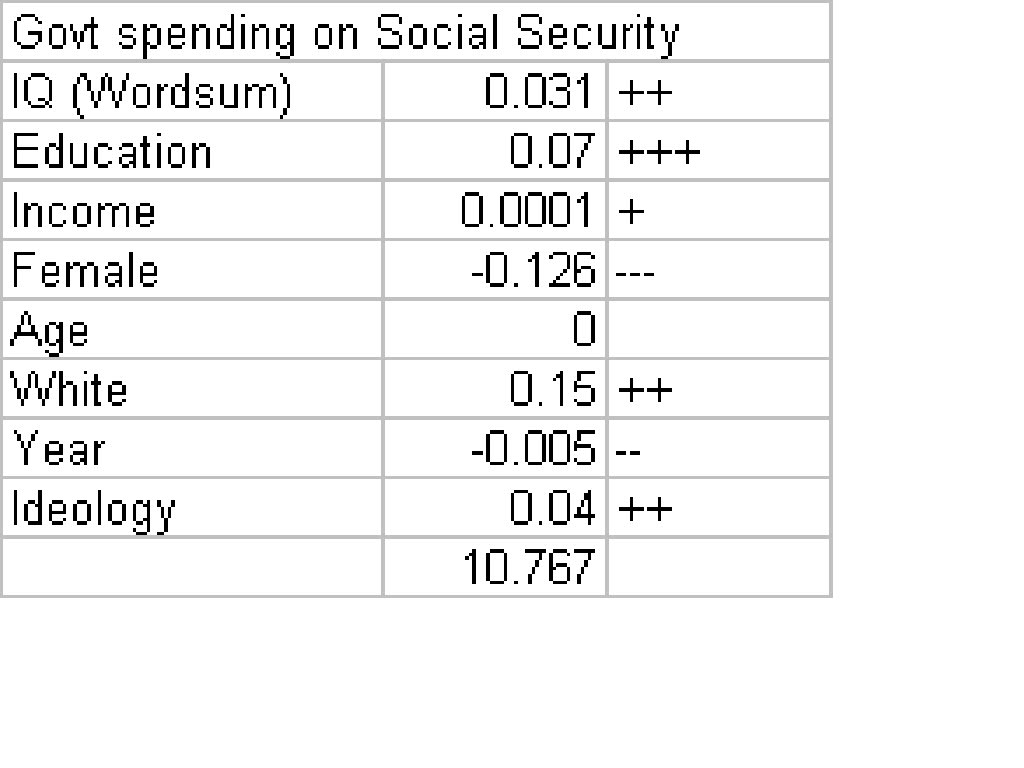
The regression analysis below shows that the potential interest factors do not account for the Smart Vote on Social Security – the role of intelligence remains strong.


I don’t know why the Smart Vote changed its mind on lowering social security spending. There is no change in the stupidity of increasing social security spending so presumably there are good reasons for keeping costs within bounds e.g. the long term viability of social security. Maybe the fund was under pressure but has since become sounder, making the downsides of poorer old people less justifiable? Perhaps the fund didn’t need to spend as much before the baby boomers hit retirement age so it was wise to save more, but now it has more people to spend on and less room to save?

The Smart Vote favors less retirement spending by government outside of social security. The table below however shows that the Smart Vote is marginal when controls are added, and so may be the result of bias.


Notice that the Smart Vote on welfare and social security spending has been sort of in the direction of prudent politically conservative preferences. It’s wise for the government not to get carried away by the needs of the poor and elderly, and lose sight of the country’s ability to pay for welfare and social security. It also appears stupid for government to think of a social safety net as one of its core responsibilities. Such a safety net is more of a ‘nice to have’ when the country can afford it.

On previous posts the Smart Vote came out on the side of liberal preferences. The Smart Vote is in fact not for global political liberalism or conservatism per se. There appears to be wisdom and stupidity on both sides of the political divide.

Thursday, November 24, 2011

Freedom of Speech and Keeping Secrets

A few days ago the African National Congress – ruling party in the South African government – passed a ‘Protection of Information’ act that is patently aimed at protecting the corruption of ANC politicians from being exposed. This makes the legal watching and reporting on government behavior almost impossible. They of course say it’s necessary because important state secrets are vulnerable. No one outside the ANC thinks this is true. Indeed it’s difficult to imagine that the South African state needs to keep anything secret at all. The justification for keeping secrets is to gain an advantage over a competitor or enemy and to prevent them from gaining an advantage over you. Another reason is that you are up to something that is likely to be frowned upon. Now of course when at war a whole country stands to gain or lose an advantage or might be embarrassed, but there is no prospect of being at war and the state is a monopoly and has no competitors in South Africa. If there is no reason to fear foreigners it seems suspiciously like the state needs to keep secrets because it has reason to fear the opinion of the people themselves.

Another thing the ANC wants to do is have a media tribunal because according to them the press tends to publish a lot of lies or misinformation about politicians and then does a very bad job of retracting allegations when they prove to be false. This is probably partially true, although the ANC exaggerates the extent of it or illegitimately views an alternative interpretation to their preferred one to be false. The press has however also published a lot of embarrassing truths (or legitimate alternative understandings) about politicians. The proposed body will no doubt squash these too and they shouldn’t be allowed to.

Freedom of speech and press freedom are two fairly central principles in most democracies. However most of the population thinks that at least one viewpoint shouldn’t be allowed to be aired in public so the principle of freedom of speech generally prevails in spite of the will of the people rather than because of it. Does that mean freedom of speech or press freedom is not such a wise idea?

I ran this issue through the Smart Vote. The General Social Survey has 6 questions relating to whether various groups should be allowed to air their views in the USA. These are – racists, homosexuals, militarists, communists, anti-religionists and Muslim clerics preaching hatred of the US. For each of the first 5 about one third of the population wants to see them kept quiet and for the last more than half do. I had a look at the ratio of smart to stupid people who support allowing each of these groups to speak. As you can see from the graph below the ratio for each issue is always very high – above 150. Indeed the above 120 IQ group came close to full support on many issues whereas only a minority of the below 85 IQ group ever supported allowing any of them to speak. The graph entitled “All” refers to allowing all of the first 5 groups to speak i.e. no exceptions. [The Muslim cleric question wasn’t included because it has only been asked recently.] As you can see the Smart Vote on the more radical “All” category is especially strong – as is allowing hate speech by Muslim clerics.


Of course this may simply reflect special interests or biases that just happen to align with IQ. I ran some logistic regressions to control for a variety of groups that may have special interests. The + and – below refer to the strength of the independent relationship of the independent variable to the dependent variable i.e. the group allowed to speak.


As should be plain IQ is still very strongly related to allowing any of these groups to speak even after controlling for these other factors. Being well educated, wealthier, younger, white or liberal predisposes one to support free speech more readily. On most questions, except homosexuality, males are also more prone to support free speech. Note also that there is a trend toward greater support for free speech in recent times.

On a few question I could find the group mentioned in the GSS. You can see the table of the regression that includes the group membership (under “Interest”) below. For Homosexuals the variable was “Sexual Orientation”, for Communism it was “Opinion of Communism” and for Anti-religionists it was “Confidence in Existence of God”.


Also the racist question already included a direct interest group i.e. race. Of the four where I was able to find a group three of the groups were clearly more in favor of their interests being aired or banned (for racism and atheism). For the homosexuals they are universally in favor of being able to have their say but the numbers of cases are too low to show statistical significance. Smart blacks are in favor of allowing racists their say. Smart anti-communists and strong believers in God support allowing communists or vocal atheists to argue their points. Note that higher IQ still favors allowing free speech.

What this means is that even among people who are conservatives that think communism is the worst possible system the brighter they are the more they think communists should be allowed to speak i.e. the more they support the airing of a view they hate. Alternatively among liberals who don’t think communism is necessarily bad the more stupid are more inclined to still deny communists a voice i.e. to restrict even those they don’t necessarily regard as a threat.

The Smart Vote on allowing free speech, especially where the view might be offensive or disturbing, is particularly strong. Disallowing anyone to make the case for something they believe in or hold dear is plainly stupid – even if a majority of the population can’t see that.

Now what about state secrets? Below is a table where I list a number of relevant questions and what the Smart Vote and Stupid Vote is for that question. The Stupid Vote is simply the alternative with the lowest ratio of high IQ to low IQ opinion.


On government maintaining secrets the intelligent view is that they either probably should or probably shouldn’t. Nowhere is intelligent opinion an unequivocal yes. That is however the stupid opinion on intelligence budgets, military technology and domestic terrorism. On military operations the stupid view is to definitely not keep them secret. So in general it is probably wise for the state to avoid making secrecy the default policy. The default should rather be openness unless there is a very good reason e.g. where the element of surprise is crucial – like military operations. The Smart Vote is unsure whether the state overdoes secrecy but it is clearly dumb to think it’s unlikely.

It is the Smart Vote to allow the publication of leaked government plans e.g. for the economy.

Since it’s wise to think that when government makes mistakes the official concerned won’t be corrected there should be some means for the public to know about it and act on it themselves.

In any case it’s intelligent for citizens to keep a close watch on government (and stupid not to) and to engage in civil disobedience if necessary. It’s also intelligent to allow a lot of leeway for citizens to protest against their government and stupid to disallow it – except for physical damage. Being allowed to publish anti-government protests is part of that.

Finally although the Smart Vote is for some method of ensuring media responsibility it is not in favor of the state disallowing publication – even when the price is the violation of the privacy of politicians.

In sum, the wise allow everyone to argue their case – no matter who it offends or disturbs. There is an intelligent case to be made for some state secrets but secrecy should not be the default, it should be the exception. States may well be overdoing secrecy and it is wise to enable citizens to watch the state and protest (and even resist) if necessary. It’s wiser for the press to be free to publish leaked state plans and the doings of politicians, even if this is sometimes unfair. It would be downright stupid for a state to make everything a secret or a crime to expose its activities or misbehaving functionaries.

In terms of serving the country they are meant to govern the ANC have taken a stupid step. The only reason I can see to justify it is that they are up to something that can’t be done unless the public is kept in the dark. This must mean that they want to do things that won’t be in the interest of the public. If so then they are no longer serving the country but using the country to serve themselves. It will come to bit them eventually but how long will the country have to suffer before they wake up to the Smart Vote?