Introduction
A while ago while reading Bryan Caplan’s blog EconLog, he alerted me to The Philpapers Surveys on philosophy. This survey asked some 3226 actual and potential philosophers their views on 30 philosophical questions. It also calculated correlations (for 931 philosophy professors) between the answers, and between the answers and their philosophical field and the philosophers they identified with. This is where I come in. I can’t resist the allure of a correlation, especially when applied to the results of serious thinking.
I decided to focus on a few questions of particular interest to me. These deal with ethical theory and political philosophy. I only looked at the question on normative ethics and the question on political philosophy. The normative ethics question asked which of the three main schools of normative ethics - deontological, consequentialist or virtue ethics - the philosopher found most convincing or compelling. The political philosophy question asked which of three main political philosophies – communitarian, equalitarian or libertarian – the philosopher found most convincing or compelling. I figured that a person’s preference for any of these views will tend to hang together with, or be conditioned by, a host of other philosophical positions. If so, the results may shed some light on why the chosen ethic, or political philosophy, tended to be more convincing than the others. All I did was note how each choice correlated with other philosophical preferences and then I summarize the results into a somewhat simplified picture.
Choice of Ethical Philosophy and philosophical fellow travelers.
Deontology
I’ll start with normative ethics. Deontological ethics is about adherence to rules or principles. It is a ‘duty’, ‘obligation’ or ‘rule’ based ethics. The 10 Commandments are an example. An action is right or wrong in and of itself, and not because of the outcome it may lead to. Deontology is a moral absolutism in the sense that an act is wholly right or wrong in this philosophy. For example, it remains wrong to lie even if the lie were to result in the avoidance of much suffering. The notion of ‘rights’, especially natural rights, is part of this ethical philosophy.
Deontology has been criticized for failing to justify the authority of the rules, and because it is vulnerable to incoherence via contradictions and conflicts.
I found that a preference for deontology tends to go with a philosophical idealism or anti-materialism – the notion that minds are not physical, that complete free will exists, that value statements in general have a ‘truth’ value e.g. aesthetics is objective, and that the truth is ‘out there’ in a sort of world of PlatonicForms that can be accessed through pure reason or in the form of a priori knowledge. Empirical work is unnecessary as knowledge is directly available through pure thought. There is a greater tendency toward theism in those who chose this form of ethical philosophy. A good example of this outlook is their tendency to believe that zombies are metaphysically possible.
Deontologists tended to avoid philosophical fields that have a materialist bent e.g. philosophy of science, or probabilistic decision making e.g. decision theory, and had a greater tendency to focus on fields where rules could be prescribed e.g. political philosophy, philosophy of law, normative ethics, and philosophy of religion. They don’t however favor any particular political philosophy.
The appeal of rules of behavior that have pretensions toward absolute truth and authority, seems to be grounded in a more general tendency to believe in the reality of abstractions, and to consider these to be above mere the material.
Consequentialism
Consequentialism is the view that the ultimate basis for any judgment of the rightness of an act is the consequences of the act. If the consequences are good then the act is moral. Morality in this view is not absolute but proportional to the good done or harm avoided. One of the better known consequentialist views is utilitarianism, where the aim of ethics is the greatest happiness for the greatest number.
It seems intuitively obvious that behavior that makes lives better is praiseworthy but consequentialism has been criticized. It is said to permit the unfair imposition of a cost on people who have done no wrong, if the overall consequences are thereby increased. The problem of measuring goodness of outcome has always plagued consequentialism. It’s very difficult, if not impossible, to find a common scale, and even there was one it’s very difficult to rule out contrary long term consequences. It has also been argued that consequentialism is too demanding intellectually and that it requires an attitude to be so impersonal as to be alienating.
Unsurprisingly, given that deontology and consequentialism are often contrasted, I found that favoring this form of normative ethic tends to be related to favoring a naturalistic view of the world, and a physical view of the mind. The will is not seen as completely free (if at all) but subject to material causes and effects. Consequentialists tend to believe that the contents of the mind are ‘pictures in the head’ and de-emphasize the ‘feel’ of mental experience. They tend to believe that although zombies are conceivable, they are metaphysically impossible. They are also more likely to be atheists. To them psychological continuity determines whether someone is the same person over time.
Consequentialists deny that values can have a ‘truth’ value, or that any a priori knowledge is possible. Naturally they are more inclined to see the need for empirical evidence and have less faith in arm chair rationalism, than deontologists. They are less likely to be worry about ‘how do you know that’ questions and to focus on the fit between belief and the real world.
Consequentialists tend to favor philosophical fields that have a materialist bent, or involve some kind of optimization problem e.g. decision theory, and they avoid conservative philosophical fields. Politically they tend to favor egalitarianism and reject communitarianism.
A preference for consequentialism seems to be part of a general tendency to believe in material cause and effect, and disbelieve in the reality of abstractions. With such a world view the calculus of material harm or welfare may seem to be the only meaningful option.
Virtue Ethics
Here the driving force of morality is not adherence to absolute principles, or the outcome (benefit or harm) of the conduct, but what it implies about the character of the person – the virtues or vices developed by the person. For example, saints are deemed especially moral individuals on the basis of their extreme exemplification of the four cardinal virtues of wisdom, justice/fairness, courage/fortitude and temperance/moderation, and the three religious virtues faith, hope and charity/love. Purity is another popular virtue. Some Buddhist virtues are compassion and discipline. Badness, on the other hand, is seen as the possession of certain vices e.g. wrath, greed, sloth, pride, lust, envy and gluttony.
This approach has been criticized because there is cross cultural and historical disagreement on what the virtues and vices are, and because the approach often doesn’t tell one what to do in any specific situations. For example, murder isn’t condemned as wrong. Rather the murderer is seen as lacking compassion or fairness. For Nietzsche however, this relativism and lack of focus on the act per se, are things to be sought rather than avoided.
I found that philosophers who favored virtue ethics tended to believe that the mind isn’t physical, emphasize the ‘feel’ of mental experience and don’t think mental experience is necessarily connected to sensory data, but they do think mental content is partly determined by outside influences. They also tend to believe in a completely free will.
Virtue ethicists tend to think knowledge or truth depends to some extent on context or perspective. They think of truth in terms of ‘how do you know that’ and have doubts about how much one can really know.
They tend to believe that whether a person remains the same person depends on more than psychological or bodily continuity, and in particular deny that psychological continuity is decisive.
Virtue ethicists are more likely to be theists and to focus on religious and political philosophy, particularly Ancient Greek or Medieval philosophy. They are less likely to be involved in science or critical approaches to ethics. Politically they tend to favor the communitarian perspective and reject the egalitarian perspective.
Virtue ethicists lack the deontologist’s belief in the reality of abstractions, see more organic connections around them, and look toward a personal, traditional and community based approach rather than to cold impersonal principle or brute scientific law.
Choice of Political Philosophy and philosophical fellow travelers.
Egalitarianism
Egalitarianism is a school of thought that favors some kind of equality between people (or even living things). The basic presumption is that people have the same fundamental worth e.g. in the eyes of God, or because we all have the same quality of being rational and therefore should be given the same consideration and respect. Politically this implies being treated as equals and having the same political, social, economic and civil rights. Social equalitarianism stresses greater equality of economic outcomes and/or political power – preferring decentralized power.
The basic presumption of equal worth has been questioned. For much of human history this presumption has been denied and even today people don’t really act as though they believe it. If an average egalitarian had to decide between whether a film star or a random working class stranger got a kidney, most wouldn’t be willing to make the decision by tossing a coin. Another criticism is that it is often anti-meritocratic.
I found that egalitarians tended to view the mind in physical terms and consider the will to have limited freedom from cause and effect. They de-emphasize the ‘feel’ of mental experience and emphasize the ‘picture in the head’ view. They believe psychological continuity determines whether someone remains the same person over time.
Egalitarians tend to believe that truth doesn’t depend much on context or perspective. They don’t think truth applies to moral statements. Although much religion is in principle egalitarian, in practice egalitarians are more likely than non-egalitarians to be atheists. Ethically, egalitarians think personal character is unimportant but good outcomes are important.
As philosophers they tend toward normative ethics and political and legal philosophy, and avoid philosophical history and religious philosophy.
It’s not at all clear from their other philosophical beliefs why egalitarians favor equality. Insofar as egalitarianism is part of progressivism the picture makes more sense. They are more likely than non-egalitarians to be secular humanists that stress material welfare.
Libertarianism
Libertarianism is a group of philosophies that stress freedom, individual liberty and voluntary association. It generally favors limited to zero government. Some forms of libertarianism regard property rights as the basis of liberty (and favor capitalism), and other regard property as a threat to liberty (and favor socialism).
Libertarianism has been criticized for championing individual liberty to the exclusion of all other values and hold that it should never be sacrificed in the pursuit of other values and causes. Compassion, justice, civic responsibility, honesty, decency, humility, respect, and even survival of the poor, weak, and vulnerable - all are to take a back seat. Sometimes this bias leads to extreme positions e.g. the moral value of saving the lives of a multitude of poor people simply does not register when compared with minor infractions against the liberty of a rich person.
As befitting the origin of the term I found that libertarianism is strongly associated with a believe in free-will libertarianism i.e. the idea that free will is incompatible with determinism, and that since we have free will determinism is false. It endorses the notion that mental experience is fairly independent of external influence. The ‘feel’ of mental experience is emphasized and the ‘picture in the head’ view de-emphasized.
Libertarianism tends to go with the view that there is no necessary connection between moral convictions and moral motives.
As philosophers they prefer the hard sciences, and stay away from the philosophy of life or social issues. They also seem to favor religious philosophy or metaphysics and are more inclined than non-libertarian philosophers to be theists. Naturally they identify more with philosophers with an individualist focus and those that hold that the world we have is the best possible world. They disavow philosophers who wanted to apply the same rules to all, or argue for some kind of collectivism.
It seems that libertarian philosophers are very struck by the feeling that their thinking and choices are self-determined, and they obviously want to extend this liberty into the practice of their lives. If our minds are so free to make choices then it’s entirely appropriate to expect people to decide their life courses themselves, and to respect their choices.
Communitarianism
Communitarianism is an ideology that emphasizes the connection between the individual and the community. In their view ideologies are incoherent if they see communities as being voluntarily chosen by ‘pre-community’ individuals. Instead they emphasize the role of the community in forming and shaping individuals, and they believe this community role is insufficiently recognized in liberal (or individualist) theories of justice. Politically communitarians tend to be leftist on economic issues and conservative on social issues. In this sense they are the opposite of libertarians who believe in property.
Communitarianism has been criticized for leading to moral relativism, for being too defensive of the status quo (which may include many unsavory practices e.g. 2nd class status for women), for standing in the way of progress, and for considering the community or the state as foundational. It has also been accused of being authoritarian and promoting prejudice.
I found that philosophers who favored communitarianism tended to be similar to libertarians in having a strong belief in free-will libertarianism, and stressing the independence of mental life from outside causation and the ‘feel’ of mental experience.
They differed in having a more non-naturalist or non-physical perception of life. They tended to believe in the reality of abstractions and the truth value of moral statements. They believed that it required more than psychological and biological continuity to determine if a person was the same person over time.
Communitarians tended to be theists and are more likely to be attracted to religious or ancient philosophy, as well as philosophical history. They tended to avoid fields such as normative ethics or political philosophy.
Finally, they prefer a virtue ethics perspective and reject consequentialism.
Communitarian philosophers tend to believe in the reality and authority of some non-material, or non-natural, realm, and they seem to venerate the wisdom of the past and the building of character.
Conclusion.
Philosophers are generally not fools. Philosophy is close to having the brightest practitioners among all the intellectually demanding professions. Furthermore philosophers comprehensively pick apart the grounding and implications of any view, and have spent years, if not decades, doing so. Chances are they really do understand the strengths and weaknesses of their views.
What does all this tell us about the relative virtues of different political ideologies? Not much really. A lot of questions were not asked e.g. existentialism, pragmatism, and those that were asked were too vague. They could have distinguished between left or right libertarianism, egalitarian communist or equal opportunity and rights liberal, etc. Still the questions and correlations do shed a little light on the reasons why these ideologies are compelling to those who adopt them, but not to those who don’t.
We can say that a strong secular materialist world view predisposes you toward an egalitarian/progressive political ideology and a consequentialist moral outlook, simply because material cause and effect is more salient and meaningful.
We can say that those who have a rather strong belief in free-will will be predisposed toward either a libertarian or communitarian/conservative political ideology, depending on how idealist or non-materialist they are. The more they lean toward materialism the more libertarian they tend to be. Since there tends to be a negative relationship between belief in free-will and a materialist outlook, one would suspect that libertarians have an almost supernatural belief in free-will.
A hypothesis occurs to me. It seems to me that the social liberal-conservative dimension lines up with a materialist-idealist dimension, and that the economic liberal-conservative dimension lines up with the degree to which free-will is believed in. So I’m thinking liberals/socialists will be high materialism low free-will believers, libertarians high materialism high free-will believers, conservatives low materialism high free-will believers, and true populists/communitarians low materialism low free-will believers.
Scientists are more likely to be in the high materialist low free-will quadrant. A Pew survey of scientists found that Democrats/liberals are highly over-represented and Republican/conservatives highly under-representative among them.
One would expect someone in the low materialism low free-will quadrant to believe that supernatural agencies play an active determinative role in everyday life. I think there is plenty of evidence that true populists/communitarians are among the most religious in a literal fundamentalist sense.
Libertarians I know (and have read about) do seem to maintain beliefs in both materialism and a strong form of free-will.
The conservative combination of belief in personal responsibility and less welfare in the economic realm with a less permissive attitude to social questions, would seem to match a belief in a will free enough to rise above circumstances while at the same time believing in the existence of a moral rules that go beyond mere material welfare.
Deontologists seem to be the moralizers across all ideological camps.
I suspect much of these belief patterns reflect one’s basic personality and temperament. Professional philosophers are by no means immune to this influence. Ben-Ami Sharfstein’s book The Philosophers details the close connection between the personal demons of various famous philosophers, and the philosophy they developed. It’s as though each philosopher’s philosophy was painted in such a way as to harmonize their own personal psychological dynamics and their relationship to how the world is. Each philosophy is an attempted solution to a personal problem. So to some extent you need to share that problem before the philosophy is likely gel with you.
It remains to be seen whether problem type is basically genetic, or whether they arise because of some childhood family dynamics and the like. If the latter it will be interesting to describe the etiology of the core problem leading to various political ideologies. On the other hand heritability estimates of the left-right dimension are fairly high, so genetically based temperament probably plays a fairly strong role. We will always have representatives of the full spectrum of ideologies, although the balance might change if certain camps start out breeding others. Right now conservatives/communitarians are out breeding liberals/libertarians.
It may seem like the world would be a better place if everyone had the same ideology, but I think that would be a mistake because each ideology acts in part as a corrective to the excesses of the others. For example, without some conservative to slow them down progressives may push change to absurd lengths – think grand social engineering, like communism. If there were no progressive to drive change a society of conservatives may never develop at all.
In the future I hope to explore what intelligence would have to say about all this. I can tell you that the Smart Vote is decidedly in favor of social liberalism and moderately in favor of economic free markets (see for example my post on economic freedom .) I don’t know what ethical philosophy will be seen as most in line with differences in intelligence.
Monday, February 20, 2012


Tuesday, January 31, 2012
Thinking about Extramarital Sex
Introduction
Extramarital affairs are fairly common. Estimates are that by the age of 60 somewhere between 50-60% of men and 40-50% of women will have had at least one incident of extramarital sex.
Affairs are generally very intense and passionate and sometimes loving but tend to end painfully in an average of 2 years. However both men and women who have had affairs consider it a good experience. Some affairs evolve into intimate friendships, and those that do can last a lifetime.
A major motive for having an affair is dissatisfaction with one’s marriage. In fact many who have affairs claim that it helps their marriage, but the evidence is that affairs do not stabilize marriages. The desire for a new mate may be compelling and seemingly irresistible but having an affair is very risky because a fairly high percentage of divorces are the direct result of infidelity.
Slightly less than 15% of couples are currently in marriages where they agree that it is acceptable to pursue sex outside their marriage however most partners deceive their spouse rather than negotiate an open marriage. Furthermore open marriage is not a successful means of preventing divorce. More than half of all open marriages end in divorce.
Another option is swinging. In swinging both partners in a committed relationship agree, as a couple, for both partners to engage in sexual activities with other couples as a recreational or social activity. It provides sexual variety, adventure, the opportunity to live out fantasies as a couple without secrecy and deceit, and the possibility of reconnecting physically and emotionally. About 5% of married couples have been engaged in swinging at some time. Active swingers tend to be happier with their sex life, marriages and life in general than non-swingers, and women were just as happy with the arrangement as men. However when swinging works it’s because the marriage was solid and happy to begin with. Swinging too is not a solution to a bad marriage.
So there are reasons to have extramarital sex and reasons not to have it, and large proportions of the adult population find themselves on either side of the divide. The question I want to deal with in this post is whether having extramarital sex is a smart or foolhardy thing to do.
Attitudes and morality
Let’s start with attitudes toward the acceptability of extramarital sex. Although the practice is very common, social norms in virtually every society are opposed to the open and flagrant practice of it. In the table entitled ‘Smart Vote Score’ the first 4 rows tell the tale of the acceptance of extramarital sex. Opinion differs strongly and systematically along IQ lines. Smart opinion fairly decisively rejects (and stupid opinion accepts) the notion that extramarital sex can never be OK. On the other hand this trend doesn’t imply that extramarital sex is generally OK either. The biggest ratio of smart to dull opinion was found on the “Extramarital Sex is Almost Always Wrong” option, and the next highest ratio on the “Sometimes Wrong” option. So while the bright are much more likely than the dull to think there are circumstances where extramarital sex is not immoral or a mistake, they are also more likely to think these circumstances are fairly unusual and rare. (Bright means an IQ over 116 and dull an IQ below 88.)

Moral philosophy agrees with the conclusion of the Smart Vote perfectly. It concludes that an affair is wrong most of the time but that there are exceptions. There are three basic approaches to morality – utilitarianism, deontology and virtue ethics. Justifications for affairs can be made in all three approaches. Utilitarianism says having an affair is wrong because it can hurt your spouse (as well as children, other family, friends and co-workers). On the other hand maybe you believe you and your affair partner stand to gain more than the sum of all the hurt, or that by not having an affair you (and your paramour) will suffer more than everyone else will gain in happiness. Maybe the person figures that even if it does create a net hurt in the short term in the long term things will be better for everyone. This approach is very demanding with respect to the foresight it requires, so even though it concludes exceptions are sometimes justified it also concludes that the odds are against a good outcome.
Deontology says affairs aren’t wrong because of consequences but because it involves violating important principles – like the duty to keep a promise, tell the truth or respect your spouse, or it violates the other’s right to fidelity, respect and the truth. However, most deontologists place conditions on duties and rights, e.g. ‘thou shalt not kill unless your own life is at risk’. A deontological condition for fidelity would be things like a spouse not neglecting their duty to see to your emotional needs. This approach requires less in the way of insight than utilitarianism because it refers to clear conditions around your rights and duties rather than guessing how a multitude of people will feel.
Virtue ethics says affairs should be avoided because they would smear those qualities that make you a good person – or character - even if only in your own eyes. Being honest, kind or wise are obvious examples of virtues one should strive to have to be a good person. Some that are outstanding with respect to certain virtues are deemed so good they are declared saints. Fidelity is generally seen as one of the virtues one should have to be a good person. Nonetheless sometimes virtues clash. For example one can be honest to the point of telling unkind truths that hurt, in which case you are failing to be kind, and perhaps failing to be wise too. Virtue ethicists such as Aristotle therefore argued that one not take any virtue to the extreme but try to find some balance or practice moderation. Goethe too preached balance. With respect to affairs there will be some circumstances where remaining faithful would not be virtuous e.g. where denying your own wellbeing is unwise and dishonest to yourself.
The justifications of moral philosophy aside, research suggests that one of the biggest contributing factors to affairs is simply opportunity. So those with greater means of controlling their time, and meeting people, are more likely to have affairs. In fact, the greater independence of men almost fully explains why they are more likely to have affairs. When the opportunity is the same, women have affairs as readily as men. That’s why it’s important to control for social class and income, along with marital happiness. The results of a multiple linear regression on attitude to extramarital sex (controlling for important confounding factors) can be seen in the table below entitled ‘Extramarital sex is not wrong’.

As expected, higher social class is associated with greater acceptance of extramarital sex (especially for men), and being older and more conservative with being less accepting of it. Unsurprisingly, marital unhappiness is clearly a major factor in accepting extramarital sex. There is also a trend toward less tolerance for affairs in more recent years. Nonetheless, even when all these risk factors are controlled, intelligence remains associated with accepting extramarital sex (at a very high level of significance for both sexes).
Behavior
Attitudes are one thing but actually engaging in extramarital sex is another. The 5th and 6th rows of the table above, entitled ‘Smart Vote Score’, show the ratio of smart to dull people who have actually had affairs, or haven’t had them, by gender. Bright men are 30% more likely to have affairs than dull men. Bright women are 50% more likely than dull women to have an affair. Alternatively bright men are 80% as likely as dull men to remain sexually faithful to their spouse. Bright women are only 75% as likely as dull women to remain faithful. (Bright means an IQ over 116 and dull an IQ below 88.)
The table entitled ‘Have had extramarital sex’ below shows the results of a logistic regression on having an affair with a number of risk factors controlled.

Unexpectedly, unlike with attitudes, social class doesn’t seem to play a role in actually having an affair. For men there is a similar trend toward less infidelity in recent years. Conservative men are also less likely to have affairs. There is a trend toward older men being more likely to have had an affair, no doubt because they had far more time. Again, as expected, marital unhappiness is associated with having affairs. Strangely age, ideology and the fashion of the day don’t have any significant effect on female infidelity. Still higher intelligence increases the odds of an affair even when all these risk factors are controlled. This result suggests that intelligent opinion leans toward the benefits of infidelity often outweighing the risks or costs.
Combining behavior and attitudes.
Interesting things happen when one combines attitude and behavior. I call those who both accept that extramarital sex is sometimes justified, and have had extramarital sex, ‘swingers’. Those who ethically accept that extramarital sex can be justified but haven’t been unfaithful I call ‘open’. Those who think extramarital sex is wrong but have had an affair anyway, I call ‘cheaters’. Finally those who consider infidelity to be wrong and have been faithful I call ‘traditional’. Rows 7-10 in the table above entitled ‘Smart Vote Scores’ show that brighter people support all options other than ‘traditional’ in greater proportions than do dull people. Nonetheless the ratio of smart to dull support for ‘cheating’ is close to equal. The Smart Vote is thus not for ‘cheating’ but goes to the ‘open’ group for men (although the ‘swinger’ group is pretty much the same) and strongly for the ‘swinger’ group for women.
The table entitled ‘Attitude and Behavioral Interactions on Extramarital Sex’ below shows the results of a multiple linear regression on the combination variable (scored as shown below the title) with the usual risk factors controlled.

For women being liberal and unhappily married move her from ‘traditional’ toward ‘swinger’. Other factors do not appear to matter much. For men, extra time to have an affair and the status of higher education also make the move more likely. The effect of higher intelligence still matters for men even after controlling for the risk factors (and comes close to significance for women). There is however some noise in this combination variable.
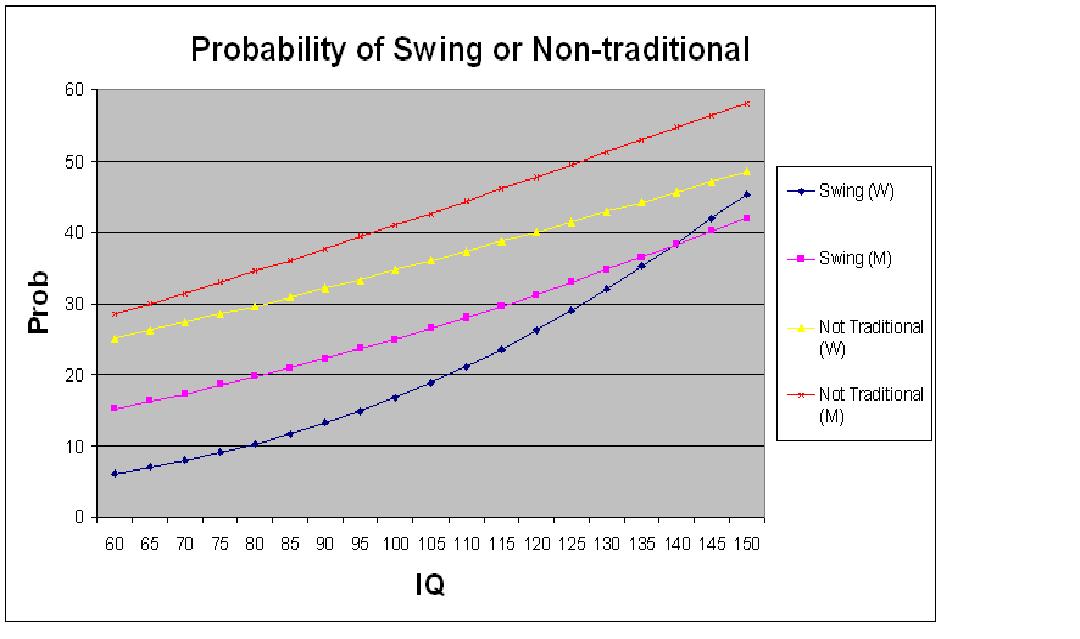
The graph below looks at the extreme groups – ‘swingers’ and ‘traditional’ (or rather ‘not traditional’). The chance of a person rejecting strict fidelity, in attitude, behavior or both – ‘not traditional’ - climbs from about 1/3rd for low IQs to around ½ for high IQs. The effect is slightly stronger for men. The chance of accepting both attitude and behavioral violations of marital sexual fidelity – ‘swinger’ - rises from 16% in low IQ men to just over 40% for very bright men. For women the change is even more marked – from 7% to 46%.

Many years ago I conducted some research relating a variety of personality scales to sexual attitudes and behavior in women. One of the personality scales was the California Psychological Inventory, which includes a scale called Intellectual Efficiency. This is a scale made up of personality items and interests that correlate highly with IQ. The total of this scale is so highly correlated to IQ that it can serve as a rough IQ test. I found that this scale correlated very highly with many sex related items – particularly those concerned with sexual permissiveness, and impersonal sex (or sex as recreation) such as swinging, sexual attraction toward women, group sex or orgies. Smarter women were very much more accepting of these activities. Alternatively, those who were accepting of these activities were much smarter than those who weren’t. They start expressing positive attitudes toward and admitting to taking part in some of these activities, when their IQs exceed around 130.
Summary
It appears that it’s silly to demand or expect strict sexual fidelity in marriage at all costs. It is often the sensible thing to do if trapped in an unhappy marriage, and not because it will help to preserve the marriage but because the marriage is probably not worth preserving. Also within happy and stable marriages swinging apparently adds spice to life without threatening, and usually enhancing, the relationship. The fact that the Smart Vote is for extramarital sex, implies that too much stress is being put on the costs, and too little on the benefits, of sexual relationships outside of marriage. Still, it is also silly to undertake sexual infidelity thoughtlessly. Most of the time, extramarital sex really is the wrong thing to do. Perhaps those who would struggle to think through the issues should avail themselves of help. My results suggest that anyone who isn’t smart enough to get through university should ask for wise independent council to help them think the issues through before embarking on extramarital sex.
Extramarital affairs are fairly common. Estimates are that by the age of 60 somewhere between 50-60% of men and 40-50% of women will have had at least one incident of extramarital sex.
Affairs are generally very intense and passionate and sometimes loving but tend to end painfully in an average of 2 years. However both men and women who have had affairs consider it a good experience. Some affairs evolve into intimate friendships, and those that do can last a lifetime.
A major motive for having an affair is dissatisfaction with one’s marriage. In fact many who have affairs claim that it helps their marriage, but the evidence is that affairs do not stabilize marriages. The desire for a new mate may be compelling and seemingly irresistible but having an affair is very risky because a fairly high percentage of divorces are the direct result of infidelity.
Slightly less than 15% of couples are currently in marriages where they agree that it is acceptable to pursue sex outside their marriage however most partners deceive their spouse rather than negotiate an open marriage. Furthermore open marriage is not a successful means of preventing divorce. More than half of all open marriages end in divorce.
Another option is swinging. In swinging both partners in a committed relationship agree, as a couple, for both partners to engage in sexual activities with other couples as a recreational or social activity. It provides sexual variety, adventure, the opportunity to live out fantasies as a couple without secrecy and deceit, and the possibility of reconnecting physically and emotionally. About 5% of married couples have been engaged in swinging at some time. Active swingers tend to be happier with their sex life, marriages and life in general than non-swingers, and women were just as happy with the arrangement as men. However when swinging works it’s because the marriage was solid and happy to begin with. Swinging too is not a solution to a bad marriage.
So there are reasons to have extramarital sex and reasons not to have it, and large proportions of the adult population find themselves on either side of the divide. The question I want to deal with in this post is whether having extramarital sex is a smart or foolhardy thing to do.
Attitudes and morality
Let’s start with attitudes toward the acceptability of extramarital sex. Although the practice is very common, social norms in virtually every society are opposed to the open and flagrant practice of it. In the table entitled ‘Smart Vote Score’ the first 4 rows tell the tale of the acceptance of extramarital sex. Opinion differs strongly and systematically along IQ lines. Smart opinion fairly decisively rejects (and stupid opinion accepts) the notion that extramarital sex can never be OK. On the other hand this trend doesn’t imply that extramarital sex is generally OK either. The biggest ratio of smart to dull opinion was found on the “Extramarital Sex is Almost Always Wrong” option, and the next highest ratio on the “Sometimes Wrong” option. So while the bright are much more likely than the dull to think there are circumstances where extramarital sex is not immoral or a mistake, they are also more likely to think these circumstances are fairly unusual and rare. (Bright means an IQ over 116 and dull an IQ below 88.)

Moral philosophy agrees with the conclusion of the Smart Vote perfectly. It concludes that an affair is wrong most of the time but that there are exceptions. There are three basic approaches to morality – utilitarianism, deontology and virtue ethics. Justifications for affairs can be made in all three approaches. Utilitarianism says having an affair is wrong because it can hurt your spouse (as well as children, other family, friends and co-workers). On the other hand maybe you believe you and your affair partner stand to gain more than the sum of all the hurt, or that by not having an affair you (and your paramour) will suffer more than everyone else will gain in happiness. Maybe the person figures that even if it does create a net hurt in the short term in the long term things will be better for everyone. This approach is very demanding with respect to the foresight it requires, so even though it concludes exceptions are sometimes justified it also concludes that the odds are against a good outcome.
Deontology says affairs aren’t wrong because of consequences but because it involves violating important principles – like the duty to keep a promise, tell the truth or respect your spouse, or it violates the other’s right to fidelity, respect and the truth. However, most deontologists place conditions on duties and rights, e.g. ‘thou shalt not kill unless your own life is at risk’. A deontological condition for fidelity would be things like a spouse not neglecting their duty to see to your emotional needs. This approach requires less in the way of insight than utilitarianism because it refers to clear conditions around your rights and duties rather than guessing how a multitude of people will feel.
Virtue ethics says affairs should be avoided because they would smear those qualities that make you a good person – or character - even if only in your own eyes. Being honest, kind or wise are obvious examples of virtues one should strive to have to be a good person. Some that are outstanding with respect to certain virtues are deemed so good they are declared saints. Fidelity is generally seen as one of the virtues one should have to be a good person. Nonetheless sometimes virtues clash. For example one can be honest to the point of telling unkind truths that hurt, in which case you are failing to be kind, and perhaps failing to be wise too. Virtue ethicists such as Aristotle therefore argued that one not take any virtue to the extreme but try to find some balance or practice moderation. Goethe too preached balance. With respect to affairs there will be some circumstances where remaining faithful would not be virtuous e.g. where denying your own wellbeing is unwise and dishonest to yourself.
The justifications of moral philosophy aside, research suggests that one of the biggest contributing factors to affairs is simply opportunity. So those with greater means of controlling their time, and meeting people, are more likely to have affairs. In fact, the greater independence of men almost fully explains why they are more likely to have affairs. When the opportunity is the same, women have affairs as readily as men. That’s why it’s important to control for social class and income, along with marital happiness. The results of a multiple linear regression on attitude to extramarital sex (controlling for important confounding factors) can be seen in the table below entitled ‘Extramarital sex is not wrong’.

As expected, higher social class is associated with greater acceptance of extramarital sex (especially for men), and being older and more conservative with being less accepting of it. Unsurprisingly, marital unhappiness is clearly a major factor in accepting extramarital sex. There is also a trend toward less tolerance for affairs in more recent years. Nonetheless, even when all these risk factors are controlled, intelligence remains associated with accepting extramarital sex (at a very high level of significance for both sexes).
Behavior
Attitudes are one thing but actually engaging in extramarital sex is another. The 5th and 6th rows of the table above, entitled ‘Smart Vote Score’, show the ratio of smart to dull people who have actually had affairs, or haven’t had them, by gender. Bright men are 30% more likely to have affairs than dull men. Bright women are 50% more likely than dull women to have an affair. Alternatively bright men are 80% as likely as dull men to remain sexually faithful to their spouse. Bright women are only 75% as likely as dull women to remain faithful. (Bright means an IQ over 116 and dull an IQ below 88.)
The table entitled ‘Have had extramarital sex’ below shows the results of a logistic regression on having an affair with a number of risk factors controlled.

Unexpectedly, unlike with attitudes, social class doesn’t seem to play a role in actually having an affair. For men there is a similar trend toward less infidelity in recent years. Conservative men are also less likely to have affairs. There is a trend toward older men being more likely to have had an affair, no doubt because they had far more time. Again, as expected, marital unhappiness is associated with having affairs. Strangely age, ideology and the fashion of the day don’t have any significant effect on female infidelity. Still higher intelligence increases the odds of an affair even when all these risk factors are controlled. This result suggests that intelligent opinion leans toward the benefits of infidelity often outweighing the risks or costs.
Combining behavior and attitudes.
Interesting things happen when one combines attitude and behavior. I call those who both accept that extramarital sex is sometimes justified, and have had extramarital sex, ‘swingers’. Those who ethically accept that extramarital sex can be justified but haven’t been unfaithful I call ‘open’. Those who think extramarital sex is wrong but have had an affair anyway, I call ‘cheaters’. Finally those who consider infidelity to be wrong and have been faithful I call ‘traditional’. Rows 7-10 in the table above entitled ‘Smart Vote Scores’ show that brighter people support all options other than ‘traditional’ in greater proportions than do dull people. Nonetheless the ratio of smart to dull support for ‘cheating’ is close to equal. The Smart Vote is thus not for ‘cheating’ but goes to the ‘open’ group for men (although the ‘swinger’ group is pretty much the same) and strongly for the ‘swinger’ group for women.
The table entitled ‘Attitude and Behavioral Interactions on Extramarital Sex’ below shows the results of a multiple linear regression on the combination variable (scored as shown below the title) with the usual risk factors controlled.

For women being liberal and unhappily married move her from ‘traditional’ toward ‘swinger’. Other factors do not appear to matter much. For men, extra time to have an affair and the status of higher education also make the move more likely. The effect of higher intelligence still matters for men even after controlling for the risk factors (and comes close to significance for women). There is however some noise in this combination variable.
The graph below looks at the extreme groups – ‘swingers’ and ‘traditional’ (or rather ‘not traditional’). The chance of a person rejecting strict fidelity, in attitude, behavior or both – ‘not traditional’ - climbs from about 1/3rd for low IQs to around ½ for high IQs. The effect is slightly stronger for men. The chance of accepting both attitude and behavioral violations of marital sexual fidelity – ‘swinger’ - rises from 16% in low IQ men to just over 40% for very bright men. For women the change is even more marked – from 7% to 46%.
Many years ago I conducted some research relating a variety of personality scales to sexual attitudes and behavior in women. One of the personality scales was the California Psychological Inventory, which includes a scale called Intellectual Efficiency. This is a scale made up of personality items and interests that correlate highly with IQ. The total of this scale is so highly correlated to IQ that it can serve as a rough IQ test. I found that this scale correlated very highly with many sex related items – particularly those concerned with sexual permissiveness, and impersonal sex (or sex as recreation) such as swinging, sexual attraction toward women, group sex or orgies. Smarter women were very much more accepting of these activities. Alternatively, those who were accepting of these activities were much smarter than those who weren’t. They start expressing positive attitudes toward and admitting to taking part in some of these activities, when their IQs exceed around 130.
Summary
It appears that it’s silly to demand or expect strict sexual fidelity in marriage at all costs. It is often the sensible thing to do if trapped in an unhappy marriage, and not because it will help to preserve the marriage but because the marriage is probably not worth preserving. Also within happy and stable marriages swinging apparently adds spice to life without threatening, and usually enhancing, the relationship. The fact that the Smart Vote is for extramarital sex, implies that too much stress is being put on the costs, and too little on the benefits, of sexual relationships outside of marriage. Still, it is also silly to undertake sexual infidelity thoughtlessly. Most of the time, extramarital sex really is the wrong thing to do. Perhaps those who would struggle to think through the issues should avail themselves of help. My results suggest that anyone who isn’t smart enough to get through university should ask for wise independent council to help them think the issues through before embarking on extramarital sex.
Friday, January 13, 2012
Dear God
By chance I came across some articles and debates involving the late Christopher Hitchens on the question of the existence of God, and the reasonableness of religion. Hitchens was vehemently anti religion but many of his pro religion opponents were very able and erudite people. There is no doubt the existence of God is a very controversial question with a great deal at stake. Those who believe invest a great deal of time and resources into their faith. If they are wrong they face the realization that this has been an enormous waste of the limited time they have and will look ridiculous for having an imaginary friend. If they are wrong then if they had put their weight behind secular humanism mankind would be far better off than it is today. If they are right however those who don’t believe may face a much graver fate and may be missing out on a more meaningful life now.
In the US 60% of the adult population are certain of God’s existence. On the other hand atheists are becoming a lot more aggressive and vocal. The divide is being expressed in the struggle over the teaching of evolution or intelligent design at schools. Muslim medical students in the UK recently walked out of class in protest of evolutionary approach taken in the course. I have heard both prominent atheists and a Christian bishop claim, with equal arrogant certainty that the other side privately knows that God doesn’t or does exist. The truth is so obvious to either side that they literally can’t comprehend that someone could genuinely hold a different view. Intellectual argument seems to have very little influence either way. This is one of those issues where there aren’t an infinity of possible answers where you never know if you are right. In this case there are only two options – God exists or does not exist – and one of them has to be right. So which camp is right?
Although the two camps don’t seem to respond to reasoned argument the Smart Vote is still perfect for this sort of question. People usually don’t form opinions on the basis of a carefully reasoned argument but instead use arguments to justify their choice after the fact – explaining why those who have already formed opinions don’t change them in response to the other side’s rationalizations. Intelligence is not however irrelevant to the forming of unreasoned opinions. The smart tend to be more correct even when they can’t tell you why they believe something. So if opinion differs systematically along IQ lines, and it cannot be accounted for by vested interest in the answer, then the option preferred more often by the more intelligent is extremely likely to be the correct option.
Let’s look at what the Smart Vote says about the existence of God. The General Social Survey asks several questions that are relevant to this issue. The first asks about the person’s confidence in the existence of God. Several alternatives were allowed.
1. Confident that God does not exist
2. It is not possible to know whether God exists or not
3. Does not believe in God but believes in some higher power.
4. Basically doesn’t believe in the existence of God but sometimes doubts.
5. Basically believes in the existence of God but sometimes has doubts.
6. Is very confident, if not certain, that God does exist.
I used those responses to form a scale of the degree of confidence in God’s existence. 0 would mean that everyone picked option 1 and 100 that everyone picked option 6. 80 means that the sample has settled on option 5 and 60 that they settled on option 4 etc. Below is graph of the scale over time.

There is a very mild trend toward greater disbelief over time. Below an IQ of 116 there are systematic differences but these are modest. Those who have an IQ above 116 however are considerably and consistently less confident that God exists. While the rest basically believe in God, but have the occasional doubt, the bright tend to hover between belief and disbelief, with a fair amount of doubt either way. Nevertheless it looks like the direction of intelligent opinion, the Smart Vote, points squarely away from theism. I did a linear regression so that I could control for a few possible confounding variables. The results can be seen in the left column in the table below.

Women, those who are older or more conservative are more likely to believe that God exists, while those with more education and who are more intelligent are less likely to believe. The association between IQ and non-theism holds up when these variables are controlled. So the Smart Vote is for atheism then. Actually it isn’t.
When I calculated the Smart Vote for each of the alternatives allowed in the General Social Survey question I found the following.

A value above 100 implies that the intelligent favor the alternative more than do the unintelligent and a value of less than 100 implies the opposite. One can see that while the Stupid Vote is for Belief in God the Smart Vote is for Agnosticism – the view that the existence or non-existence of God cannot be established either way – and not Atheism (the conviction that God does not exist). In fact in the earlier period Atheism wasn’t even the second most intelligent choice, Belief in a Higher Power was. There has however been a shift toward the more disbelieving alternatives being smarter over time. For example the Smart Vote on Atheism increased from 121 to 131, and for Sometimes Believes it increased from 85 to 117. At the same time the Smart Vote dropped from 166 to 120 for Belief in a Higher Power and from 114 to 106 for Sometimes Doubt.
Another way of looking at the question is by seeing who changes their mind. The General Social Survey had some information on that too. Firstly they asked directly about changes of belief in God and allowed four choices.
1. Don’t believe in God and never did (Smart Vote 178).
2. Don’t believe in God but used to (Smart Vote 241).
3. Believe in God now but didn’t before (Smart Vote 122).
4. Believe in God and always did (Smart Vote 66).
Firstly, whether one ends up a believer or a non-believer, it is smarter to have started from the opposite view.
Secondly, for those that didn’t change their mind about God, non-belief is smarter than belief.
Thirdly, for those who did change their minds, going from a belief to non-belief is smarter than going from non-belief to belief.
Fourthly, if one started with non-belief, it is smarter to stay there than become a believer.
Finally, if one started as a believer then it is far smarter to lose the belief than keep it.
In short, everything points towards the intelligence of changing from believing in God to not believing in God, and that whatever one believes, having to change one’s view to get there takes more intelligence than staying in one’s comfort zone.
A final way the General Social Survey allows us to look at the question is via shifts among those that believe in God i.e. between fundamentalist, moderate and liberal religious beliefs from what they were at 16 to what they became as an adult. The right hand column of the regression table above shows the results of a regression on the degree of change from fundamentalist to liberal. The scale went from -2 for a change from liberal to fundamentalist to +2 for change from fundamentalist to liberal. As can be seen, IQ is independently and significantly associated with the degree of shift towards the liberal side, and away from the fundamentalist side. What that means is that smarter people are more inclined to cease believing in some of the more literal religious beliefs or alternatively less intelligent people are more likely to seek more literal and less contingent religious views. Younger, more liberal people and males are more likely to change from a fundamentalist to a liberal religious view. There is also a significant trend over time towards a more liberal religious outlook.
So even among those that believe, it is smarter not to take religious stories and claims literally and maybe not to believe many of them at all.
I have seen a study that looks at belief in groups with much higher IQs than are represented in the General Social Survey and the trend toward less belief with higher IQ shows no sign of tapering off at even the highest IQs. As we saw though, the effect only seems to start in earnest at an IQ of 116. For 85% of the population IQ has less effect. Disbelief in God seems to be quite a difficult problem to think about.
At every point along the continuum of belief in God, from absolutely certain literal belief to atheism, the intelligent response is always to move further away from belief in God. The only position more intelligent than atheism is agnosticism.
Thursday, January 12, 2012
The Grass IS Greener on the Other Side.
With the exception of alcohol and nicotine recreational drug use is illegal in most places in the world. Most take it so seriously that using drugs will get you fired, expelled or even some jail time. Supplying drugs is very likely to result in jail time, and in a few places will get you executed. It’s reasonable to conclude that drugs must constitute a serious threat to social order and wellbeing, if so many societies punish it so harshly. Stories of the problems drug users can cause families, not to mention the violent crime around the supply chain, seem to reinforce this view.
On the other hand a World Health Organization survey found quite high user rates. In the US for example 42.4% of adults used marijuana. If such a high proportion of the population use it, without society collapsing, can it be so bad? Some don’t think so. There have been many attempts to have marijuana use made legal. Generally these attempts have failed but in a few places they do succeed.
In this article I turn the torch of intelligence on the issue of marijuana legalization.
The Smart Vote is clearly for legalizing marijuana, or grass. The graph below shows the support, by IQ level, over time. There was a major drop in support during the Reagan and Bush administrations but support has steadily increased since then. It doesn’t look like changes in support for legalizing grass have much to do with intelligence. Nevertheless at all times there was a clear ordering of support for legalizing grass along IQ lines i.e. the Smart Vote always pointed toward legalizing grass being the correct idea.

Maybe the Smart Vote effect is just due to special interests. Recreational drug use is after all something more common in affluent societies and groups. I ran two separate logistic regressions so that the downward trend over time till 1992 and the upward trend since then would hide each other or dampen any other effects. The table below shows the results.

The different trends for the two time periods show up very clearly. As expected youth, being more liberal or male go with support for legalizing grass. On the other hand that education and income are unrelated is unexpected. For our purposes though the association between higher IQ and support for legalizing grass holds up when these confounding variables are controlled. The independent effect of IQ is so strong that it has a less than 1 in 10000 probability of being due to chance. We can therefore rule out interest biases relating to these variables accounting for the Smart Vote.
But why should legalizing grass be the correct thing to do?
Economists have long argued that the war on drugs is counterproductive. For example of Chicago University’s Economics Expert Panel 100% agreed that making drugs illegal raises the street price of the drugs because suppliers require extra compensation for the risk of incarceration and other punishments. 79% of them agreed that the Netherlands restrictions on “soft drugs” combined with a moderate tax aimed at deterring their consumption would have lower social costs than continuing to prohibit use of those drugs as in the US. Only 2% disagreed and the rest were uncertain.
The evidence suggests these economists are right. Attempting to outlaw an essentially victimless crime (or very low victim), greatly encourages serious crime with a far higher victim count. The experience of the Prohibition in the USA strongly supports this. Policing drugs uses up resources and manpower that could be better employed elsewhere. Furthermore, if it were legal it can be used as a government revenue stream.
With respect to drug usage becoming a social problem, note that making drug use illegal doesn’t reduce the actual use of them much, if at all. Some places where cannabis is illegal, like France or the US, have higher user rates than some places where it is basically legal, like the Netherlands or Spain. The US has a user rate of 42.4% for marijuana and 16% for cocaine. For the Netherlands the rates are 19.8% and 1.8% respectively. Furthermore the Netherlands has about 60% of the problem drug user rate as similar countries in Europe. It looks like the other measures the Netherlands takes to discourage drug use work quite well.
It makes no sense for something to be illegal if it is demonstrably less harmful than something which is legal. Yet cannabis continues to be illegal in most places, in spite of scientists classifying it as a ‘softer’ drug than alcohol.
Legalize grass (and maybe recreational drugs in general) – it’s the right thing to do.
Monday, January 9, 2012
The Stupidity of Opposing Gay Rights
Homosexuality, “the love that dare not say its name”, is far more widely accepted than it used to be. People aren’t jailed for being gay anymore, and gay bashing is way down. Overall public support for the right of homosexuals to marry has quadrupled, and opposition nearly halved, between 1988 and 2010. Opinion is evenly divided on whether homosexuality is a choice or something that cannot be changed. Almost all gays of course think it isn’t a choice and that they should have the right to marry.
Still a great deal of opposition to homosexuality remains. It’s regarded as unnatural, sinful, immoral, debauched, promiscuous, an aberration and a threat to normal ways of being and not too long ago was classified as a mental illness. While support is increasing for gay marriage resistance to it is formidable. For example 42 states define marriage as the union between one man and one woman and 30 of these states have gone so far as to add amendments to their constitutions banning gay marriage, in order to make any future recognition far more difficult. In 18 states the constitution bans any kind of same sex union. Some states grant some rights to same sex unions e.g. right of hospital visitation. Only 5 states have, or soon will, recognize same sex marriages and a total of 6 (plus the District of Columbia) recognize some form of same sex civil union or domestic partnership.
One would like to know whether homosexuality is a threat to be concerned about and contained or discouraged, or whether it is a normal harmless option that should be embraced, or is it something in between? In this article I will look at what light intelligence can shed on this. My information comes from the General Social Survey and Kinsey’s two volumes on Human Sexuality.
Is Homosexuality a Choice?
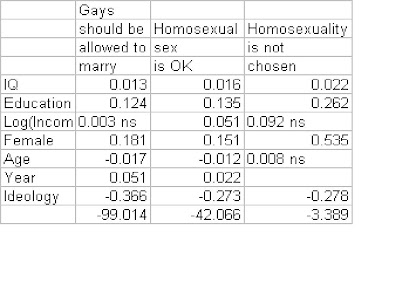
Here the Smart Vote is very decidedly for homosexuality not being a choice. Nearly 2/3rds (63.5%) of those with IQs below 88 believe gays chose to be homosexual. In contrast 74.3% of those with IQs above 116 believe sexual orientation is not something that can be chosen. This association holds up when confounding factors like education, political ideology and gender are statistically controlled (see the right hand column in the table “Regression Analysis of Attitudes toward Homosexuals” below.)
The Smart Vote is broadly correct but strictly speaking the true situation is a bit more complicated. Some people can change their sexual orientation. Occasionally the anti-homosexual therapy practiced by some fundamentalist Christian churches does work. In response to the AIDS crisis there was a detectable increase in the proportion of both sexes who had sex exclusively with women. Furthermore, gay sex between female swingers is very common – even among those with a long pre swinging history of exclusively male partners. This suggests that to some extent – at the margin as economists would say - sexual orientation is susceptible to incentives.
Nonetheless it’s also clear that very few people do change their sexual orientation and that the orientation seems to exist from the very moment people first become sexually interested. Twin research shows that sexual orientation is moderately heritable. The locus is probably mostly on the X-chromosomes because males have a much stronger either-or sexual orientation than women. There are proportionally fewer male than female bisexuals and proportionally more males than females are exclusively homosexual. Other research has shown that gays have differences in certain brain structures and that these differences may be caused be stress during pregnancy e.g. an especially high proportion of the children born to women who experienced the WW2 bombing of London turned out to be gay. All this points to sexual orientation being inborn – either genetically based or a biological response to circumstances.
Why then can a few change their orientation? Alfred Kinsey had the answer. He showed that sexual orientation isn’t clearly either-or but that there is a continuum from exclusive heterosexuality to exclusive homosexuality. By far the majority are exclusively heterosexual in that they only ever been sexual with the opposite sex. He recognized 6 other categories of sexual orientation. The first 5 grade from mostly heterosexual to mostly homosexual and the sixth is exclusively homosexual. The ability to shift sexual orientation is probably limited to those in the 5 intermediate categories who are significantly attracted to both sexes because they have to choose to focus on one of two likes rather than swap a like for a dislike.
If sexual orientation is correlated with IQ then one would suspect that choice was possible, and that there existed a correct choice. On the other hand, one would expect deliberate rational consideration to be impotent if choice was irrelevant, or played an insignificant role. It turns out that there is also no statistically significant association between declared sexual orientation and intelligence – further supporting the view that sexual orientation isn’t really a choice.
Is Homosexual Sex Wrong?
The General Social Survey has asked this question since the 70s. In the graph below you can see that there has been a shift toward greater tolerance for homosexual sex across all IQ groups, since about 1990. The other obvious thing is that tolerance is consistently higher as IQ increases. The Smart Vote leans toward viewing homosexual sex as never or seldom wrong. Furthermore this association holds up well when confounding variables are controlled (see the second column in the table “Regression Analysis of Attitudes toward Homosexuals” below). Morally condemning homosexual sex is, among other things, stupid.

Should Same Sex Marriage be Legally Recognized?
Considering that the Smart Vote says that sexual orientation isn’t something chosen and that there is nothing wrong with gay sex, it would be a surprise is the Smart Vote opposed same-sex marriage. It doesn’t of course, as the graph below makes clear. Support for legalizing gay marriage has consistently been higher among higher IQ groups since the GSS began asking this question. The association also holds up well when confounding factors are controlled (see first column in the table “Regression Analysis of Attitudes toward Homosexuals” below).

Regression Analysis of Attitudes toward Homosexuals
Summary of Attitudes Toward Homosexuality
The Smart Vote is for acceptance of homosexuals and homosexuality. It is very probably correct to believe that homosexuals aren’t choosing homosexuality at all (let alone for dubious motives), and that it is rather a state of being they are more or less born into. As such homosexuality is no threat to those who aren’t already gay, and trying to stamp it out will achieve nothing but the senseless suffering of gay people. There is therefore no good reason to attempt to contain homosexuality. Furthermore it is correct, and more compassionate, not to condemn gays when they try to live and gain satisfaction according to their nature, by having homosexual sex, or by wanting to form a union or family with those they love. In an earlier post on free speech the Smart Vote was also in favor of protecting the civil rights of homosexuals.
In the regressions one can see that education, being female or liberal (and probably young) predispose people to greater tolerance of homosexuality – quite apart from higher intelligence, and visa versa.
Homosexual Behavior
Kinsey found that 28% of all women had some kind of erotic reaction to other women in their lives, and 20% had acted on it - 13% to the point of orgasm. He found that men had 2 to 3 times these response rates. For unmarried women 14% were asexual, 72% were heterosexual (or very close to it), 6% were homosexual (or close to it) and 8% were bisexual. For men the figures are more like 5% asexual, 74% close to heterosexual, 14% close to homosexual and 7% bisexual. Even among the married, homosexual experience is not so rare. 3% are at least bisexual, but if they are far along the Kinsey scale they are quite likely to get divorced. Around 1 in 20 people who consider themselves straight have had sex with a member of the opposite sex – often more than once. Being religiously devout doesn’t make a person immune to homosexual feelings or activities either. But what purpose could it serve for a straight person to have a homosexual experience?
The table below looks at homosexual experience by intelligence level, and is confined to those who consider themselves straight. The way to read it is as follows. The first column of figures is the % of those with zero homosexual experience in each of the intelligence categories i.e. 16% of those with no homosexual experience at all are Smart. The next column is the same for those who have had at least one homosexual experience. The third column is the % of each intelligence category that has had at least one homosexual experience i.e. 4.6% of the dull have had one. The final column is the ratio of each intelligence category’s % homosexual experience over that of the Stupid category i.e. Smart women are 43% more likely to have a homosexual experience.

I calculated a Smart Vote index for homosexual experience for each gender. For women it is 144 and for men it is 172. That means is that the propensity to have homosexual sex (relative to not having it) is 44% higher for women with IQs over 116 than it is for those with IQs less than 88. That’s very close to the Smart/Stupid ratio. For Smart men the propensity is 72% higher than for Stupid men. In other words for a straight person to have at least one homosexual experience is if anything an intelligent thing to do, and is probably not so pointless. This seems to contradict my earlier point that sexual orientation isn’t a choice because it seems as though homosexuality or bisexuality, is not only a choice, but is the correct choice!
The paradox is resolved when potentially confounding factors are controlled for. When they are the IQ association doesn’t hold up. What looks like an intelligent decision is due to something correlated to intelligence, rather than intelligence itself. For women it’s education. Maybe it’s the ‘experiment in college’ thing or maybe greater autonomy from men allows them to live their real choices more. For men it is higher income. I have no idea why more money translates into a greater chance of gay sex among straight men.
For both there is a sign that the politically conservative are more likely to have a homosexual experience than liberals, although the effect is not statistically significant. Perhaps Conservatives are just more likely to declare themselves straight after having a homosexual encounter.
Sexual orientation is neither correct nor incorrect but it is correct to let gays and lesbians live their lives as they see fit – just like the rest of us.
Still a great deal of opposition to homosexuality remains. It’s regarded as unnatural, sinful, immoral, debauched, promiscuous, an aberration and a threat to normal ways of being and not too long ago was classified as a mental illness. While support is increasing for gay marriage resistance to it is formidable. For example 42 states define marriage as the union between one man and one woman and 30 of these states have gone so far as to add amendments to their constitutions banning gay marriage, in order to make any future recognition far more difficult. In 18 states the constitution bans any kind of same sex union. Some states grant some rights to same sex unions e.g. right of hospital visitation. Only 5 states have, or soon will, recognize same sex marriages and a total of 6 (plus the District of Columbia) recognize some form of same sex civil union or domestic partnership.
One would like to know whether homosexuality is a threat to be concerned about and contained or discouraged, or whether it is a normal harmless option that should be embraced, or is it something in between? In this article I will look at what light intelligence can shed on this. My information comes from the General Social Survey and Kinsey’s two volumes on Human Sexuality.
Is Homosexuality a Choice?
Here the Smart Vote is very decidedly for homosexuality not being a choice. Nearly 2/3rds (63.5%) of those with IQs below 88 believe gays chose to be homosexual. In contrast 74.3% of those with IQs above 116 believe sexual orientation is not something that can be chosen. This association holds up when confounding factors like education, political ideology and gender are statistically controlled (see the right hand column in the table “Regression Analysis of Attitudes toward Homosexuals” below.)
The Smart Vote is broadly correct but strictly speaking the true situation is a bit more complicated. Some people can change their sexual orientation. Occasionally the anti-homosexual therapy practiced by some fundamentalist Christian churches does work. In response to the AIDS crisis there was a detectable increase in the proportion of both sexes who had sex exclusively with women. Furthermore, gay sex between female swingers is very common – even among those with a long pre swinging history of exclusively male partners. This suggests that to some extent – at the margin as economists would say - sexual orientation is susceptible to incentives.
Nonetheless it’s also clear that very few people do change their sexual orientation and that the orientation seems to exist from the very moment people first become sexually interested. Twin research shows that sexual orientation is moderately heritable. The locus is probably mostly on the X-chromosomes because males have a much stronger either-or sexual orientation than women. There are proportionally fewer male than female bisexuals and proportionally more males than females are exclusively homosexual. Other research has shown that gays have differences in certain brain structures and that these differences may be caused be stress during pregnancy e.g. an especially high proportion of the children born to women who experienced the WW2 bombing of London turned out to be gay. All this points to sexual orientation being inborn – either genetically based or a biological response to circumstances.
Why then can a few change their orientation? Alfred Kinsey had the answer. He showed that sexual orientation isn’t clearly either-or but that there is a continuum from exclusive heterosexuality to exclusive homosexuality. By far the majority are exclusively heterosexual in that they only ever been sexual with the opposite sex. He recognized 6 other categories of sexual orientation. The first 5 grade from mostly heterosexual to mostly homosexual and the sixth is exclusively homosexual. The ability to shift sexual orientation is probably limited to those in the 5 intermediate categories who are significantly attracted to both sexes because they have to choose to focus on one of two likes rather than swap a like for a dislike.
If sexual orientation is correlated with IQ then one would suspect that choice was possible, and that there existed a correct choice. On the other hand, one would expect deliberate rational consideration to be impotent if choice was irrelevant, or played an insignificant role. It turns out that there is also no statistically significant association between declared sexual orientation and intelligence – further supporting the view that sexual orientation isn’t really a choice.
Is Homosexual Sex Wrong?
The General Social Survey has asked this question since the 70s. In the graph below you can see that there has been a shift toward greater tolerance for homosexual sex across all IQ groups, since about 1990. The other obvious thing is that tolerance is consistently higher as IQ increases. The Smart Vote leans toward viewing homosexual sex as never or seldom wrong. Furthermore this association holds up well when confounding variables are controlled (see the second column in the table “Regression Analysis of Attitudes toward Homosexuals” below). Morally condemning homosexual sex is, among other things, stupid.

Should Same Sex Marriage be Legally Recognized?
Considering that the Smart Vote says that sexual orientation isn’t something chosen and that there is nothing wrong with gay sex, it would be a surprise is the Smart Vote opposed same-sex marriage. It doesn’t of course, as the graph below makes clear. Support for legalizing gay marriage has consistently been higher among higher IQ groups since the GSS began asking this question. The association also holds up well when confounding factors are controlled (see first column in the table “Regression Analysis of Attitudes toward Homosexuals” below).

Regression Analysis of Attitudes toward Homosexuals

Summary of Attitudes Toward Homosexuality
The Smart Vote is for acceptance of homosexuals and homosexuality. It is very probably correct to believe that homosexuals aren’t choosing homosexuality at all (let alone for dubious motives), and that it is rather a state of being they are more or less born into. As such homosexuality is no threat to those who aren’t already gay, and trying to stamp it out will achieve nothing but the senseless suffering of gay people. There is therefore no good reason to attempt to contain homosexuality. Furthermore it is correct, and more compassionate, not to condemn gays when they try to live and gain satisfaction according to their nature, by having homosexual sex, or by wanting to form a union or family with those they love. In an earlier post on free speech the Smart Vote was also in favor of protecting the civil rights of homosexuals.
In the regressions one can see that education, being female or liberal (and probably young) predispose people to greater tolerance of homosexuality – quite apart from higher intelligence, and visa versa.
Homosexual Behavior
Kinsey found that 28% of all women had some kind of erotic reaction to other women in their lives, and 20% had acted on it - 13% to the point of orgasm. He found that men had 2 to 3 times these response rates. For unmarried women 14% were asexual, 72% were heterosexual (or very close to it), 6% were homosexual (or close to it) and 8% were bisexual. For men the figures are more like 5% asexual, 74% close to heterosexual, 14% close to homosexual and 7% bisexual. Even among the married, homosexual experience is not so rare. 3% are at least bisexual, but if they are far along the Kinsey scale they are quite likely to get divorced. Around 1 in 20 people who consider themselves straight have had sex with a member of the opposite sex – often more than once. Being religiously devout doesn’t make a person immune to homosexual feelings or activities either. But what purpose could it serve for a straight person to have a homosexual experience?
The table below looks at homosexual experience by intelligence level, and is confined to those who consider themselves straight. The way to read it is as follows. The first column of figures is the % of those with zero homosexual experience in each of the intelligence categories i.e. 16% of those with no homosexual experience at all are Smart. The next column is the same for those who have had at least one homosexual experience. The third column is the % of each intelligence category that has had at least one homosexual experience i.e. 4.6% of the dull have had one. The final column is the ratio of each intelligence category’s % homosexual experience over that of the Stupid category i.e. Smart women are 43% more likely to have a homosexual experience.

I calculated a Smart Vote index for homosexual experience for each gender. For women it is 144 and for men it is 172. That means is that the propensity to have homosexual sex (relative to not having it) is 44% higher for women with IQs over 116 than it is for those with IQs less than 88. That’s very close to the Smart/Stupid ratio. For Smart men the propensity is 72% higher than for Stupid men. In other words for a straight person to have at least one homosexual experience is if anything an intelligent thing to do, and is probably not so pointless. This seems to contradict my earlier point that sexual orientation isn’t a choice because it seems as though homosexuality or bisexuality, is not only a choice, but is the correct choice!
The paradox is resolved when potentially confounding factors are controlled for. When they are the IQ association doesn’t hold up. What looks like an intelligent decision is due to something correlated to intelligence, rather than intelligence itself. For women it’s education. Maybe it’s the ‘experiment in college’ thing or maybe greater autonomy from men allows them to live their real choices more. For men it is higher income. I have no idea why more money translates into a greater chance of gay sex among straight men.
For both there is a sign that the politically conservative are more likely to have a homosexual experience than liberals, although the effect is not statistically significant. Perhaps Conservatives are just more likely to declare themselves straight after having a homosexual encounter.
Sexual orientation is neither correct nor incorrect but it is correct to let gays and lesbians live their lives as they see fit – just like the rest of us.
Friday, December 30, 2011
Intelligent Thinking About Abortion
Abortion is an extremely divisive issue in the USA. Doctors who performed abortions have been murdered, abortion clinics have been bombed and Warren Buffett’s companies were once boycotted because his charities supported Planned Parenthood. 41% of people favor of abortion for any reason and 59% of people oppose it. For reasons of rape, mother’s health or fetal deformation, the percentage of support jumps to at least 80%.
A phenomenal number of abortions are performed every year. Almost half of all pregnancies are unintended and 40% of those are aborted, meaning that 1 in 5 of all pregnancies in the US is aborted. In 2008 1.21 million abortions were performed – down from 1.31 in 2000.
Although the overall abortion rate is declining it isn’t true for all sectors of society. The over rate of unintended pregnancies has remained stagnant but has increased by 50% among poor women and declined 29% among higher income women between 1994 and 2006. Similarly the abortion rate among the poor increased by 18% and declined 28% among the better off between 2000 and 2008. The poor or disadvantaged now account for nearly 70% of all abortions. In other words, because unplanned pregnancies are mostly a lower class phenomenon, and becoming more so, abortion is increasingly becoming a lower class phenomenon. Due to the tight relationship between IQ and social class, abortion is no doubt mostly a lower IQ problem too. Certainly the odds of an unplanned pregnancy increases strongly as IQ drops – see my post on the subject .
Since abortions are disproportionately chosen by the less intelligent maybe legal abortion is a stupid policy? On the other hand maybe the stupidity lies entirely within the unplanned pregnancy phase of the process. Maybe the abortion IQ association is entirely explained by the common connection of poverty. Let’s look at what the Smart Vote says about abortion itself. In the table below we can see that the Smart Vote is in favor of abortion being legal – especially when the reason doesn’t get general support. The Smart Vote of 187 for abortion for any reason simply means that those with IQs over 120 were 87% more likely to support abortion for any reason that those with IQs below 85.

Note that having most of the information on abortion you need is more than twice as likely among the smart but that, in spite of the greater knowledge, the Smart Vote is against forming a very firm opinion on abortion. Also, in contrast to the extreme divisiveness the issue produces, the Smart Vote is for not taking abortion issues too seriously. For example the Smart Vote is for abortion being salient only sometimes, for being not that concerned about it, and for regarding it as not very important – as opposed to abortion being salient a lot or not at all, being either very or not at all important, etc.
I still need to rule out confounding factors, like poverty, before I can conclude that the policy of legal abortion is the intelligent way to go. The table below shows the results of controlling for education, income, age, social class, political ideology (liberal versus conservative) and belief in God.
Contrary to expectations, it’s the wealthy upper classes that are more likely to think poverty a good enough reason to end a pregnancy. A small income also increases opposition to rape or not wanting more kids, as reasons for abortion. Finally the poor are more likely to think a husband’s consent is necessary to allow an abortion.
As expected, being a political Conservative and belief in God are strongly associated with being against abortion – no matter what the reason. It’s interesting that conservatism doesn’t explain the effect of belief in God, or visa versa.
There is a weak unreliable trend for older people to favor abortion – when other factors are controlled.
Greater education is associated with higher levels of support for abortion.

The interesting thing however is that being smarter is independently associated with greater support for abortion on demand. That is quite remarkable because virtually all the pro abortion control factors are correlated with IQ, and would therefore take away some of the explanatory power of IQ.
So, smarter policy is to allow abortion on demand. It’s also smarter not to place a great deal of importance or concern on abortion issues – there are more important things to focus on.
But why should pro choice be a smarter choice than pro life?
The General Social Survey offers some help. Two of the questions asked are “What reasons in favor of abortion have you heard of?” and “What reasons against abortion have you heard of?” Respondents were given the opportunity to mention up to 3 different reasons. Unfortunately the questions don’t ask whether the reasons are seen as good, bad or compelling. Nonetheless I think people are more likely to mention the reasons they, or the advocates they identify with, find relatively more compelling.
I grouped various reasons that obviously belonged together e.g. those referring to ‘rights’, ‘risk’, ‘abnormal fetuses’, ‘murder’, ‘cost’, etc. I also dropped reasons that were mentioned by fewer than 3% of respondents.
Furthermore I only looked at the “Pro” abortion reasons of those who are in favor of abortion on demand, and the “Anti” reasons for those opposed to abortion on demand. Insofar as people adopt positions after hearing arguments then those who adopt a stance are in the best position to judge what it was that convincing to them. However when people look for rationalizations after adopting a stance then those who are attempting to rationalize will be the ones who generate the rationalizations. For both reasons then, pro choicer advocates should judge the pro reasons and pro life advocates the con reasons.
Finally I applied the Smart Vote to the responses i.e. I tested the reasons to discover which were relatively smart or daft. The results are in the Table below.

Firstly, the ‘none’ category, in both the for and against camps, resulted in very low Smart Vote scores i.e. smart people are less than 1/10th as likely as dull people to fail to mention a reason for their stance. It is exceedingly stupid to stand for or against something for no reason at all.
Secondly, a woman’s autonomous right to choose is seen as an intelligent reason to allow legal abortions, and the notion that the woman’s choice should not be autonomous is seen as an unintelligent reason for disallowing legal abortions.
In his book Better Angels of Our Nature, Steven Pinker gives a superb defense of the morality of autonomous choice. “Until recently women – or rather their sexuality and reproductive capacity – were regarded as the property of men – firstly their fathers and brothers and then their husbands. The humanist mindset has changed that. Instead of grounding morality in power, tradition or religious practice it bases it on the suffering and flourishing of sentient individuals. The mindset has been sharpened into the principle of autonomy: that people have an absolute right to their bodies, which may not be treated as a common resource to be negotiated among other interested parties. For example, with regard to rape it does not seek to balance the interests of a woman not to be raped, the interests of men who may wish to rape her and the interests of the husbands and fathers who want to monopolize her sexuality. The traditional valuation is upended. Now the woman’s own interests count for everything and the interests of all the other claimants count for nothing. This revaluation also underlies the abolition of slavery, despotism, debt bondage, and cruel punishment during the Enlightenment.” “Insofar as violence is immoral, the Rights Revolutions show that a moral way of life often requires a decisive rejection of instinct, culture, religion and standard practice. In their place is an ethics inspired by empathy and reason and stated in the language of rights. We force ourselves into the shoes of others and consider their interests and ignore superficialities like age, race, gender, and even species.”
The morality of autonomous choice is the result of a morality that stresses reason. That it is seen as one of the more intelligent reasons for allowing legal abortion should come as no surprise.
Thirdly, allowing abortion when a woman’s life or health is endangered is seen as intelligent but denying the right to choose an abortion because the process of abortion itself might be risky is seen as unintelligent. Again the reasonableness of the woman making autonomous choices about her own welfare is stressed.
Fourthly, the rights of the unborn are seen as an intelligent reason for disallowing abortion. This reminds us that there are two parties with legitimate rights based stakes in the decision whether to allow legal abortion. The intelligent thing is not to forget that but there is no way to get around the issue of which party’s rights are paramount. The Smart Vote says it should be the woman’s rights. One may venture a guess at why that should be so. The woman is clearly an autonomous sentient being while the fetus is not. The earliest possibility of sentience is well after the point at which almost all abortions are performed. In any case the smarter among those who oppose abortion don’t support the idea that abortion is murder.
Fifthly, justifications based on not being able to afford a child, or unwanted children imposing too high a social cost, are not seen as reasonable grounds to have an abortion. While extra people do involve additional costs they also end up producing stuff or ideas. In fact economists have shown that additional people are a net benefit. That fact lends weight to the Smart Vote rejection of this justification of abortion.
Sixth, the Smart Vote is very weakly for rape or incest being a good reason to allow an abortion. The reason is that this is such an easy ‘problem’. Almost everyone who is explicitly asked if this is a valid reason to allow an abortion says that it is. So the fact that the Smart Vote is above 100 at all is significant i.e. rape or incest is a good reason to allow a legal abortion. The same applies to abnormalities in the child.
Finally, religion and the bible are seen as an intelligent basis for rejecting abortion. I confess that I find this difficult to explain. Religious belief and reliance on the bible are themselves both strongly rejected by the Smart Vote, and as a basis for morality religion conflicts with the humanistic reason based rights approach mentioned above. Still the fact is that the Smart Vote is decidedly for legal abortion on demand, which is consistent with placing humanistic morality above religious authority.
To summarize – seeing women (and sentient individuals generally) as autonomous moral entities rather than a common resource appears to be the intelligent way to go. Allowing women to abort their pregnancy for their own reasons, follows logically.
Friday, December 16, 2011
Trustworthy Thinking
My Awakening
One day in the midst of my primary school years I had an experience that started a train of thought that has continued ever since. A teacher asked the class what we call those sharp teeth 3 over from the centre. I, and a few other kids, answered ‘canines’. The teacher declared that answer incorrect. Perplexed I tried another answer, ‘eye teeth’. Again the teacher’s reply was no. Now I was deeply disturbed. When after a few minutes no one had supplied what she considered a valid answer, she revealed that the correct name was ‘fangs’.
Up till then I had implicitly trusted and believed adults when they told me something. In general they hadn’t contradicted each other on the facts so I had no reason not to. Suddenly one of the gods of truth proved to be not only ridiculously wrong but also incapable of learning otherwise. I foolishly corrected her. I went so far as showing her the facts in a reference book on the topic, thinking that she would be pleased to correct her error. I was rebuked in front of the class. That was the day I learned that the thinking of all adults is not equally trustworthy. I did consider the notion that this was merely a once off error on her part. Unfortunately an unhealthy fraction of the facts she taught proved to be unreliable when I checked them against encyclopedias. Perhaps she was a lone bad apple. That hope too was dashed. Other teachers proved just as bad – if not worse. A few years later another teacher instructed the class to laugh at my sister because her mother believed in evolution.
I felt disappointment mostly but some other intelligent people say they experienced anxiety when they realized they depended absolutely on very fallible people. Ever since then I have wondered about whose thinking is trustworthy. Ignorance and illogicality are widespread. My own thinking isn’t immune either. The very fact that I’ve changed my mind frequently over the years points to that. This question has morphed into wondering who should be trusted with society’s important thinking? One cannot avoid relying on one’s own thinking, even if you try to give up thinking for yourself and rely totally on someone else. Simply making that choice must have been convincing to you. Still I will be having a look at who society actually does trust to think, and whose thinking it reveres, and what mental ‘horsepower’ one needs to earn this. I hope my discussion will prove convincing for many.
Who We Trust to Think
Actually there is no single ‘trusted to think’ level – it’s a continuum. Pretty much all people are entrusted with solving some problems and not others. For example society expects virtually all of us to understand that laws exist, in part, to prevent or resolve disputes. The point of laws on many things is obvious e.g. it’s illegal to kill or steal. Society trusts that we can figure that out without special help. However there are some disputes where the right and wrong of it, and the point of the laws applying to the issue, are not clear. For that sort of problem we move trust from ordinary people to especially selected and trained people we call lawyers.
Lawyers are carefully trained to understand the complexities of the laws and the legal system, but the people who do get this training are not randomly selected. They are selected for their capacity to master the subject adequately. In the USA prospective law students are subjected to test called the Law School Admissions Test. This test heavily stresses the ability to think logically. One of three subtests is concerned with the ability to comprehend verbal arguments, but both the other subtests test the ability to make correct logical deductions, once the concepts are comprehended. Even before they start training, potential lawyers are well above average. Nevertheless at law school they are further drilled in thinking logically. Getting through that process is not the end. In order to be a reasonably successful lawyer i.e. someone a client trusts with their problem, they have to perform sufficiently well in court against others who were similarly selected and trained. Those are good reasons why lawyers are who we trust when ordinary people can’t sort out a legal dispute between themselves. The average IQ of lawyers is 127. That is at the 95th percentile and their logical ability is probably even higher. At best 1 in 10 people can be trusted with this level of thinking. Thankfully not all of them become lawyers.
I am mentioning IQ because it is a useful scheme for organizing all this information.
Judges are the second level of advisors. Society wants them to evaluate the reasoning of lawyers, and whoever else is involved in putting cases together, and decide which of these 'advisors to the population' are themselves correct or incorrect. They are chosen because they have a reputation for particularly good judgment, competence and integrity. This is reflected in the fact that the minimum LSAT score of judges puts them in the top 10% of lawyers and the top 1% of the general population. This is equivalent to an average IQ of 142.
Appeal court judges are the third and final level of advisors. (The constitutional court is really about specialist issues rather than a higher level.) They are selected on the basis of a reputation for good judgments, competence and integrity that puts them on a level noticeably above that of other judges. They are trusted to decide the 'truth' when even judges can't agree on the correct answer. The fact that their minimum LSAT score puts them in the top 1/5 of judges i.e. top 2% of lawyers, confirms it. This is equivalent to a minimum IQ of 144 and an average 148.
Doctors also have a tier system. Patients try to diagnose themselves. They fail and come to interns in the public system (or their GP). One of 3 things happens - the intern/GP gets it right and the problem clears, the intern doesn’t know or the intern gets it wrong and the problem persists. Often the intern (or the patient) asks for a second opinion but this frequently doesn’t help. Even among physicians, diagnostic disagreements run at about 50%. So when interns don’t know, or the problem persists, they refer the problem to more knowledgeable senior doctors or specialists. The process is repeated until the limit of medical knowledge is reached. If anything getting into medical school is even tougher than getting into law school, however the average IQ of basic doctors or interns is also 127. There is good evidence that medical problem solving ability (like every other problem solving ability) is highly correlated to IQ, and it is not far fetched to say that a doctor with the diagnostic ability of Dr Gregory House would have an IQ much higher than 127.
An original finding is required to earn PhD but isn’t for any lower degree, so one could argue that PhD level is where society really starts trusting people to think. The average IQ of someone earning a PhD in a STEM (science, technology, engineering or math) is 138. Tenure (in a STEM field) at a top 50 university is associated with an average IQ of 145. (See Appendix 1 for the method I used.) Another result was that a minimum of 700 on the SAT verbal is needed for truly original PhDs in English literature. That’s an IQ of 142.
What about thinkers who are not only trusted, but revered? I have in mind the award winners like Nobel Laureates in science, economics and literature, Fields Medalists or Crafoord and Abel Prize winners in mathematics, and Rolf Schock Prize winners in philosophy or mathematics. Acknowledged geniuses of the past belong here too.
Using three different methods (Appendix 2) I estimate the average IQ of those elite laureates as 149 – with a typical range of 132 to 167. The average IQ of historical geniuses is 157 – with a typical range of 150 to about 174.
The Kind of Thinking We Trust
We begin to trust people with thinking tasks when they can discover general principles and can think theoretically.
There isn’t an abrupt dividing line but below an IQ of around 116 thinking is concrete. There is little awareness of rules that may be abstracted from a number of specific situations and hypothetical reasoning tends to be about concrete situations like ‘What would A do if I did B?’, rather than abstraction like “Unemployment should rise if there is deflation.”
At IQs above 116, abstract hypothetic thinking becomes possible. At the IQ level of the average lawyer and doctor it is still quite superficial. They are adept at hypothetic thought and abstractions, and although they appreciate that their hypotheses could form a coherent whole they are generally not up to drawing out this whole themselves. At best they can develop low level individual theories but not a whole theoretical system.
Judges and STEM or good English Lit PhDs, at an average IQ level of 138-142, are at a level where they are able to create a new, coherent, abstract theoretical system. If they are to be trusted to advance our knowledge and understanding of the world they need to, and are expected to, be able to do it. Some however can’t do it very well.
Others however, do it supremely well. We tend to revere the thinking of those – like Appeal Court Judges or Nobel, Math or Philosophy Prize winners – who are very adept at creating coherent abstract theoretical systems. Even at this level there is an intellectual pecking order. There are some Nobel Laureates e.g. Einstein, Feynman, intellectuals e.g. von Neumann, or historical geniuses, that Nobel Laureates themselves revere. These are the people who can build several different coherent theoretical systems on the same information, and possibly bring them all under the ambit of a grand meta-theoretical system.
Conclusion
We turn out to trust the thinking of the intellectual elite – surprise, surprise. Those that can be trusted to think of new stuff, or with final appeals, are typically well within the top 1% - probably within the top 0.3% - of ability. These are the better PhD types (in the more demanding disciplines), tenured professors at top universities, members of the National Academy of Sciences, or final level appeal court judges. They are at home with theorizing and system building.
Of course having a high enough IQ does not necessarily mean someone can think wisely. Furthermore being able to think well is not the same as actually thinking, which is why geniuses are much rarer than IQs in the genius range. The trick is to persuade those who can think to do more of it, to do some reality checking and to apply themselves to useful problems.
There are still some issues beyond this if thinking is truly to be trusted. Many Nobel Laureates talk rubbish when they stray outside their fields. Experts are frequently wrong – particularly when hedgehog type intellectuals. Overconfidence, and failure to expose themselves to alternative viewpoints, is the main problem. Still I did learn why the thinking of teachers (mean IQs around 105) is so unreliable. Teachers aren’t known for liking students who ask searching questions either. I guess we should make it a norm to warn kids that adults – even those in positions of responsibility – seldom think clearly and correctly.
I think if we want to know the truth we should never completely trust anyone’s thinking – not least our own. We should make deliberate efforts to expose ourselves to the strongest cases for opposing viewpoints.
Appendix 1
In the Study of Mathematically Precocious Youth After 35 years: Uncovering Antecedents of the Development of Math-Science Expertise by David Lubinski & Camilla Persson Benbow the careers of the top 1% of math talent were followed. To estimate the IQs of STEM PhDs I used La Griffe du Lion’s ‘Jewish Method’ – see Method 1 in Appendix 2. I didn’t use Jews versus Gentiles but instead used the 99-99.25 percentiles and the 99.75-100 percentiles of tested math ability as my reference groups.
Appendix 2
Method 1
The first estimate of Nobel Laureate IQs I had seen was La Griffe du Lion’s use of the so called ‘Jewish Method’ in Some Thoughts about Jews, IQ and Nobel Laureates here. He takes the known IQ distributions of Jews and non-Hispanic whites in the US and using Gaussian curves finds a cut-off IQ which would give a similar ratio in the proportion of Jews and the proportion of non-Jews that fall beyond it as we find in Jewish and non-Jewish white Nobel Laureates from the US. That cut-off would be the minimum IQ. He calculated the mean Nobel Laureate IQ to be 148 (if one uses an sd of 16 rather than the 15 he did).
Method 2
For a second estimate I used figures (in Harriet Zuckerman’s Scientific Elite) of the institutions from which American Science Laureates received their PhDs compared to science PhDs in general. This information permitted me to estimate the ‘educational ability’ distribution of the science laureates in terms of the science PhD distribution. Simply find the percentile of each group that say got their PhD from an Ivy League university and the percentile of each that received their PhD from a university below a set level of selectivity. Convert the percentiles into unit normal i.e. z-scores. Find the difference between the z-scores at each defining line for each group. Now divide the science PhD difference by the Nobel Laureate difference – because the science PhD group is the reference group and if the difference of the Nobel Laureates is a higher number of z-units than the science group then the standard deviation of the laureate ability distribution must be smaller than the science PhD distribution. The ratio of the differences gives you the ratio of the laureate to the science PhD standard deviations directly. Using that I calculated the laureate mean expressed in terms of the science PhD distribution. I got 1.034±0.899 (where the science PhD ability distribution is set at 0±1.
Now the actual IQ distribution of science PhDs is 139±9.56 so the Laureate IQ distribution should be 149±8.6 and 95% of them should fall between IQs of 132-167.
La Griffe du Lion discusses the essentials of this method here. He calls it the Diversity Space method.
Method 3
For a third estimate I used national IQ figures and per capita Nobel + Math Prizes per country. By estimating the number of eligible people who lived over the full prize giving period, counting only men between 25 and 80 years old and correcting for the fact that only 25% of professionals choose science as a career, I calculated that the current populations should be divided by 6.4154 to provide a proper population baseline. Logistic regression methodology would connect the per capita probability of winning one of these prizes to national IQ. So I calculated log(p/1-p) and did a linear regression between that figure and national IQ. The linear equation was
0.2575*IQ-37.6253= log(p/1-p).
That means that someone would have a 50% chance of having the ability of winning a prize of IQ=37.6253/0.2575=146.1. This is essentially an estimate of the minimum IQ which means the average IQ would be 149.
The three methods produce almost exactly the same figure – 149 or just over 1 in 1000 people in most developed Western Countries.
Historical Geniuses
Catherine Cox (with a number of experts in IQ testing) estimated the ratio IQs of 300 historical geniuses by using biographical information to work out the age at which they mastered various tasks and then comparing it to the typical age these tasks are mastered. The result gives a mental age estimate which is then used to calculate a ratio IQ i.e. mental age/chronological age*100. Now ratio IQs are not normally distributed so I converted the ratio scores into equivalent deviation IQ scores. The IQs of the individual IQs might not be as accurate as they would be if they had been tested as children but the average IQ of the group as a whole should be very accurate. I limited the sample to scientists, mathematicians, philosophers and writers – dropping artists, musicians, statesmen, religious figures and soldiers. The kind of person included were Newton, Galileo, Pascal, Leibnitz, Descartes, Kant, Hegel, Hume, Locke, JS Mill, Goethe, Byron, Wordsworth, Milton, Dickens, Voltaire, etc. Typically the minimum IQ was 150, the median 157, and the upper end at about 174.
By the way, from the link between vocabulary size and IQ and an estimate of how many words Shakespeare knew, I estimated Shakespeare’s IQ at 172. I also used the fact that Einstein read Kant with understanding at the age of 13 (typically it takes an adult IQ of 150 to do so) to estimate his IQ at 165. This figure is in keeping with his math progress as an early teenager.
Subscribe to:
Posts (Atom)
